Selling a property is not only about the property itself. It is also about how the property is presented to potential buyers.
Today, many buyers first encounter homes, apartments, villas, offices, and investment properties through online listings. Before arranging a viewing, they may look at several property photographs and decide within seconds whether a listing deserves more attention.
This can create a challenge for vacant properties.
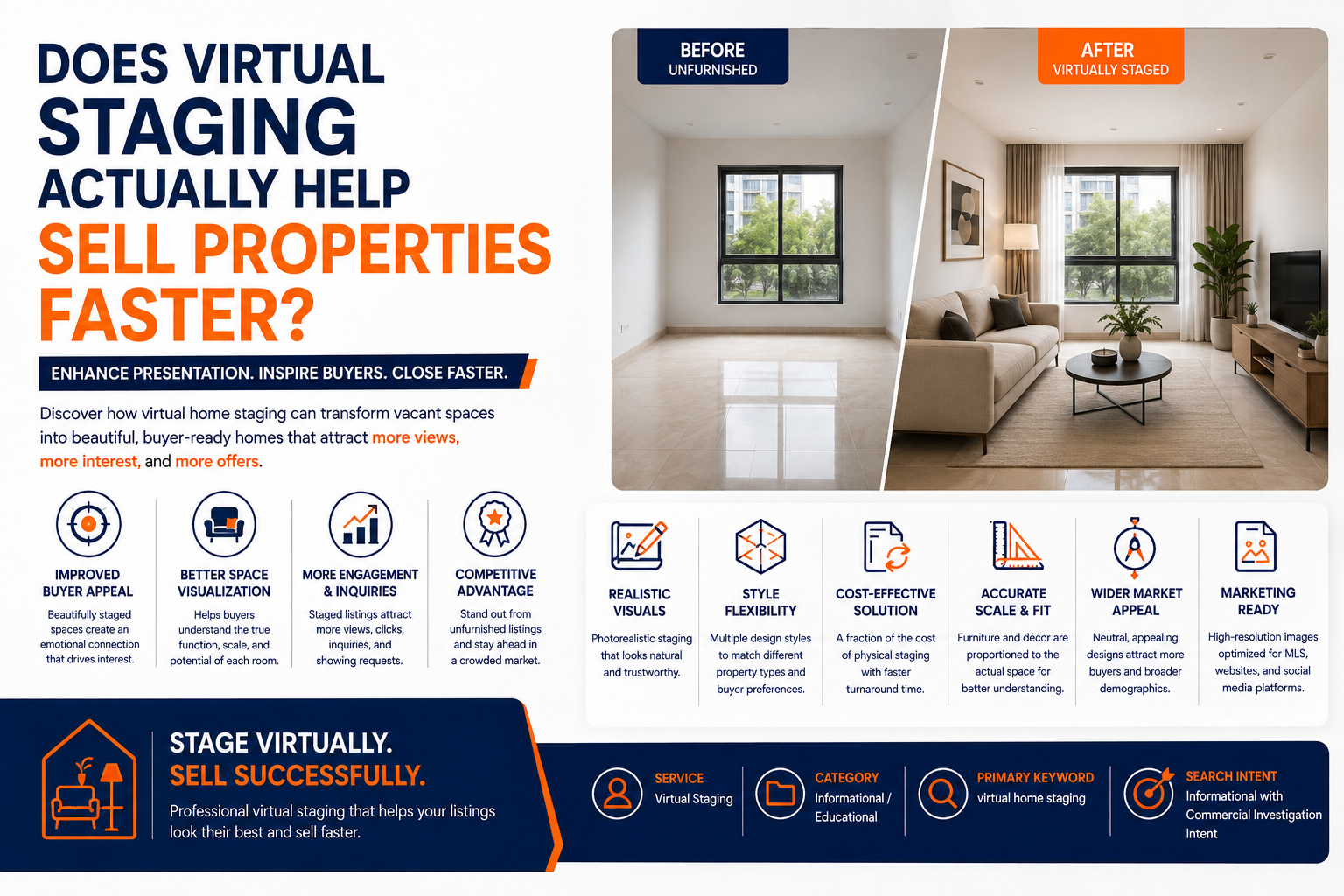
An empty room can be clean, spacious, and perfectly suitable for living, but an unfurnished photograph may make it difficult for some buyers to understand the room's purpose, scale, or potential. A living room without furniture may not immediately communicate how a sofa, coffee table, television unit, or dining area could fit into the space.
This is where virtual home staging can help.
Virtual staging digitally adds furniture, décor, lighting adjustments, and other visual elements to existing property photographs. Instead of physically furnishing a vacant property, professional editors create a digitally furnished version of the room.
But does this actually help properties sell faster?
The honest answer is: virtual staging can improve property presentation and may increase buyer engagement, inquiries, and viewing interest, but it cannot guarantee a faster sale on its own.
The result depends on many factors, including the property, asking price, location, photography quality, marketing strategy, listing platform, buyer demand, and quality of the virtual staging itself.
1. What Is Virtual Home Staging?
Virtual home staging is the process of digitally furnishing and decorating a property photograph.
An editor starts with an existing photograph of an empty or minimally furnished room and adds realistic digital furniture and décor.
Depending on the project, this can include:
- Sofas
- Beds
- Dining tables
- Chairs
- Coffee tables
- Rugs
- Lamps
- Curtains
- Artwork
- Plants
- Cabinets
- Television units
- Bedroom furniture
- Outdoor furniture
- Decorative accessories
The objective is not simply to fill an empty room.
The goal is to create a realistic representation that helps potential buyers understand the function, scale, atmosphere, and design possibilities of the space.
For example, an empty 15 × 12-foot living room may look difficult to interpret in a photograph. A professionally staged image can show a suitable sofa arrangement, coffee table, rug, lighting, and décor while preserving the room's actual architecture.
2. Why Do Empty Property Photos Sometimes Struggle?
Vacant property photographs are not necessarily bad photographs.
However, empty spaces can create several challenges for online property marketing.
Buyers may struggle to understand room functionality
A completely empty room does not always communicate how it should be used.
Is it a living room?
A family room?
A home office?
A dining area?
Furniture can provide immediate visual context.
Room proportions can be difficult to judge
Without familiar objects, some buyers may find it harder to estimate the practical scale of a room.
Furniture provides visual reference points.
Empty rooms can appear less emotionally engaging
Property buying is partly practical and partly visual. Buyers often try to imagine themselves living in the property.
A carefully staged image can help create that visual connection.
Vacant properties may need stronger online presentation
For properties marketed primarily through online listing platforms, photographs are among the first pieces of information buyers see.
Professional virtual staging can therefore become part of a broader real estate marketing strategy.
3. How Can Virtual Staging Influence Buyer Perception?
Virtual staging works primarily by improving property presentation.
Consider two versions of the same bedroom.
The first shows four walls, flooring, windows, and an empty space.
The second shows a properly scaled bed, bedside tables, lighting, curtains, artwork, and subtle décor.
The architecture has not changed.
The room has not become physically larger.
But the second image may make the space easier to understand.
This is an important distinction.
Virtual staging should visualize possibilities rather than misrepresent the property.
Professional staging can help buyers understand:
- Where furniture could be placed
- How a room could function
- Which areas could be used for dining
- How a bedroom could be arranged
- How much open floor space remains
- What type of interior style could suit the property
This can make the listing easier to interpret.
4. Can Virtual Staging Increase Buyer Interest?
It can, particularly when the property is vacant and the original photography is visually difficult to interpret.
However, buyer interest should not be confused with a guaranteed sale.
A stronger listing image may encourage someone to:
See the listing → Continue browsing → Explore more photographs → Contact the agent → Request information → Schedule a viewing
Virtual staging can potentially support the early stages of this journey.
It does not control other important factors such as:
- Property price
- Location
- Competition
- Mortgage conditions
- Market demand
- Property condition
- Agent responsiveness
- Listing quality
- Buyer budget
Therefore, virtual staging is best viewed as a property marketing tool, rather than a standalone sales solution.
5. Empty Property Photos vs Virtually Staged Photos
The difference is primarily in how the available space is communicated.
Empty Property Photo
Virtually Staged Photo
Shows the actual vacant condition
Shows a digitally furnished concept
Minimal visual distraction
More visual context
Can feel spacious but undefined
Helps communicate room functionality
Limited furniture reference
Furniture helps demonstrate scale
Useful for showing actual condition
Useful for showing design potential
Simple presentation
More engaging marketing presentation
Neither version should necessarily replace the other.
In many cases, the strongest listing strategy is to use both.
For example:
- Original vacant photograph
- Virtually staged photograph
- Additional close-up photographs
- Exterior photographs
- Floor plan
- Property details
This gives buyers both realistic property information and visual inspiration.
6. How Does Professional Virtual Staging Work?
Professional virtual staging is more than placing a furniture image over an empty room.
A good workflow typically considers several technical factors.
Step 1: Analyse the original photograph
The editor reviews:
- Camera angle
- Perspective
- Room dimensions
- Walls
- Windows
- Doors
- Flooring
- Existing architectural features
- Light direction
Step 2: Select appropriate furniture
Furniture should match the room's apparent size and purpose.
Step 3: Match perspective
The furniture must follow the same perspective as the original photograph.
Step 4: Match scale
A sofa that is too large or a bed that is too small can immediately make an image look unrealistic.
Step 5: Integrate lighting
Furniture should respond visually to the room's lighting.
Step 6: Add realistic shadows
Shadows help objects appear connected to the floor instead of floating.
Step 7: Balance colours and materials
Furniture should complement the property's walls, flooring, architecture, and existing visual style.
Step 8: Perform quality control
The final image should be reviewed for:
- Distorted furniture
- Incorrect perspective
- Floating objects
- Strange shadows
- Repeated objects
- Unrealistic reflections
- Architectural changes
- Excessive décor
This is where professional editing can make a significant difference.
7. Why Furniture Placement and Scale Matter
One of the most important aspects of virtual staging is realistic furniture placement.
Suppose a small apartment living room is staged with an oversized sectional sofa.
The furniture may look attractive individually, but it can make the room appear smaller than it actually is.
Similarly, placing a tiny dining table in a large dining area may make the room look unusually empty.
Professional virtual furniture placement considers:
- Room proportions
- Camera perspective
- Furniture dimensions
- Walking space
- Door clearance
- Window placement
- Architectural features
- Natural lighting
The goal is to create a believable arrangement.
A buyer should be able to look at the image and think:
“I can imagine living in this room.”
8. AI Virtual Staging vs Professional Virtual Staging
AI has made virtual staging faster and more accessible.
AI-powered tools can automatically identify rooms and generate furniture arrangements.
This can be useful for:
- Quick concepts
- Testing different styles
- Initial visualization
- Large image batches
- Early-stage marketing
However, AI-generated images can sometimes introduce problems.
Examples include:
- Distorted furniture
- Incorrect object proportions
- Strange textures
- Unrealistic lighting
- Repeated furniture
- Incorrect architectural interpretation
- Inconsistent room styles
- Objects appearing in inappropriate locations
Professional virtual staging typically uses a more controlled workflow.
A practical approach can be:
AI-assisted staging → professional refinement → quality assurance
This combines automation with human visual judgment.
For high-value property listings, consistency and realism are especially important.
9. Physical Staging vs Virtual Staging
Traditional physical staging involves bringing real furniture and décor into a property.
It can create an authentic physical environment, but it also requires logistics.
Physical staging may involve:
- Furniture transportation
- Storage
- Installation
- Removal
- Property access
- Scheduling
- Labour
- Furniture rental
Virtual staging removes many of these logistical requirements because the furniture is digitally added to photographs.
Physical staging
Best suited for:
- In-person viewings
- Luxury show homes
- Properties that need physical presentation
- Developers creating model apartments
Virtual staging
Best suited for:
- Vacant properties
- Online listings
- Properties photographed before furniture installation
- Remote marketing
- Multiple design concepts
- Properties where physical staging is impractical
The two approaches do not have to compete.
They can complement each other depending on the property's marketing strategy.
10. Which Rooms Should You Virtually Stage?
Not every room needs the same level of staging.
The most useful areas are usually those where furniture helps explain functionality.
Living Room
The living room is often a strong candidate because furniture can immediately communicate:
- Seating arrangement
- Entertainment area
- Walking space
- Room scale
Bedroom
A bed, bedside tables, wardrobe, lighting, and décor can help buyers understand the room's intended function.
Dining Area
A dining table and chairs can make an undefined area easier to interpret.
Home Office
A desk, chair, shelving, and lighting can show how a smaller room might function as a workspace.
Outdoor Areas
Patios, balconies, gardens, and terraces can sometimes benefit from carefully selected outdoor furniture.
The key is not to stage every available space unnecessarily.
Strategic staging is often more effective than excessive staging.
11. Choosing the Right Interior Style
Different properties appeal to different audiences.
A modern city apartment may suit a contemporary style.
A premium villa may benefit from a sophisticated luxury interior.
A compact apartment could use a minimalist or Scandinavian-inspired arrangement.
Common virtual staging styles include:
- Modern
- Contemporary
- Minimalist
- Scandinavian
- Luxury
- Classic
- Transitional
- Neutral
- Family-oriented
For example:
Modern Contemporary
Clean furniture, simple lines, neutral colours, and a polished appearance.
Scandinavian
Light furniture, simple décor, natural textures, and an uncluttered atmosphere.
Luxury
Premium-looking furniture, sophisticated lighting, refined décor, and carefully selected materials.
The style should support the property's architecture and target market rather than overpowering it.
12. Can Outdoor Areas Be Virtually Staged?
Yes.
Virtual staging is not limited to bedrooms and living rooms.
Outdoor areas can also be enhanced when appropriate source photographs are available.
Potential additions include:
- Patio furniture
- Outdoor dining sets
- Lounge chairs
- Planters
- Rugs
- Umbrellas
- Poolside furniture
- Garden seating
For example, an empty balcony may look ordinary in a listing photograph.
A tasteful outdoor arrangement can help communicate that the space could be used as:
- A morning seating area
- A small entertainment space
- A relaxation area
- An outdoor dining zone
Again, the objective should be visualization rather than creating a misleading representation of the property.
13. What About Day-to-Night Virtual Staging?
Day-to-night editing can create another visual presentation of the same property.
A daytime exterior can be transformed into a realistic evening or twilight-style image while preserving the property's architectural structure.
This can be useful for:
- Luxury properties
- Villas
- Premium apartments
- Architectural marketing
- Developer campaigns
Lighting can highlight:
- Exterior architecture
- Windows
- Landscaping
- Pools
- Entrances
- Outdoor living areas
However, this is a presentation technique and should not be confused with the property's actual lighting conditions at the time of photography.
14. When Is Virtual Staging Most Useful?
Virtual staging can be particularly useful in several situations.
Vacant properties
This is one of the clearest use cases.
Furniture helps buyers understand an otherwise empty space.
Newly constructed properties
Developers may have completed architectural spaces before interior furnishing is installed.
Virtual staging can help visualize potential interiors.
Investment properties
Investors may need clear visual presentation when evaluating rental or resale opportunities remotely.
Properties marketed internationally
For overseas buyers who cannot immediately visit the property, strong visual communication can be particularly valuable.
Properties with outdated interiors
Virtual staging may help demonstrate how a space could look with a more contemporary interior concept.
Multiple design concepts
A single room can potentially be presented in different styles, such as:
- Modern
- Contemporary
- Scandinavian
- Luxury
This can help marketing teams test different visual directions.
15. When Can Virtual Staging Have Limited Impact?
Virtual staging is not appropriate for every marketing problem.
It may have limited impact when:
The property is significantly overpriced
Better photographs cannot fix a major pricing problem.
The original photograph is poor
Low-resolution, badly exposed, or poorly composed photographs can limit the quality of the final staged image.
The property itself needs major repairs
Virtual furniture cannot solve structural or maintenance issues.
The listing lacks important information
Buyers also need:
- Accurate property details
- Measurements
- Location information
- Floor plans
- Amenities
- Pricing
- Contact information
The staging is unrealistic
Poor editing can reduce trust instead of improving the listing.
This is why virtual staging should be integrated into a broader property marketing strategy.
16. How Poor Virtual Staging Can Hurt a Listing
Professional virtual staging should enhance the property without distracting from it.
Poor-quality editing can create the opposite effect.
Common problems include:
- Furniture that is too large
- Incorrect perspective
- Floating furniture
- Unrealistic shadows
- Distorted objects
- Overly saturated colours
- Excessive decoration
- Incorrect room functionality
- Furniture blocking doors or windows
- Different visual styles across rooms
Another concern is transparency.
If a photograph has been virtually staged, listing viewers should not be led to believe that the furniture shown is physically present.
Clearly identifying virtually staged images can help maintain buyer expectations and trust.
17. How to Measure Whether Virtual Staging Is Working
If you want to know whether virtual staging is producing useful marketing results, do not rely only on whether the property eventually sells.
There are several intermediate indicators worth monitoring.
Listing views
Compare the number of listing views before and after improving the images where reliable data is available.
Click-through behaviour
Track whether stronger images encourage users to explore the listing.
Enquiries
Monitor whether the property receives more questions or contact requests.
Viewing requests
An increase in viewing interest can be a useful indicator.
Engagement
For social media campaigns, track:
- Likes
- Saves
- Shares
- Comments
- Clicks
- Profile visits
A/B testing
Where a platform allows it, marketing teams can compare different visual approaches.
For example:
Version A: Empty room
Version B: Virtually staged room
This provides more useful evidence than assuming virtual staging always works.
18. How to Choose a Professional Virtual Staging Provider
If you are considering an online virtual home staging service for real estate agents, look beyond price alone.
A reliable provider should demonstrate strong attention to:
Realism
Furniture should look naturally integrated into the original photograph.
Perspective
Objects should follow the room's camera angle.
Scale
Furniture should be appropriately sized for the room.
Consistency
Multiple rooms from the same property should feel visually connected.
Style selection
The provider should be able to adapt the staging style to the property and intended audience.
Revisions
A clear revision process makes it easier to correct furniture choices or styling preferences.
Turnaround
Real estate marketing often operates on deadlines, so turnaround expectations should be clearly communicated before the project begins.
Image quality
Final files should be suitable for the intended listing, website, brochure, or marketing campaign.
Communication
The provider should understand instructions such as:
- Stage only the living room
- Use contemporary furniture
- Keep the existing flooring
- Do not alter architectural elements
- Maintain the original camera perspective
For agencies, photographers, and developers handling multiple listings, consistent workflows can become particularly important.
Voxelhaus Consultancy approaches virtual staging as a professional property-image service, focusing on realistic digital furnishing, appropriate furniture placement, suitable design styles, consistency, and listing-ready presentation.
19. FAQs
Does virtual staging really help sell properties faster?
It can potentially help by improving listing presentation and encouraging buyer engagement, especially for vacant properties. However, it does not guarantee a faster sale because selling time depends on many factors beyond photography.
Is virtual staging better than empty property photos?
Not necessarily in every situation. Empty photos show the actual condition of the property, while virtual staging helps visualize how the space could look furnished. Using both can provide a more complete presentation.
Can virtual staging increase property buyer interest?
Professional staging may increase visual appeal and encourage buyers to spend more time exploring a listing. Actual results depend on the property, market, photography, pricing, and overall marketing strategy.
Can I virtually furnish and decorate empty property photos online?
Yes. Empty property photographs can be digitally furnished with furniture, décor, lighting elements, and other suitable visual details.
Is AI virtual staging good enough?
AI can be useful for rapid visualization, but automated results may contain distorted objects, incorrect proportions, or unrealistic details. Professional review and refinement can improve consistency and realism.
How many rooms should I virtually stage?
There is no universal number. Living rooms and bedrooms are often useful because furniture helps communicate their purpose and scale. The best selection depends on the property and marketing objective.
Can virtual staging be used for luxury properties?
Yes. Luxury properties can be digitally furnished using sophisticated furniture, décor, lighting, and interior styles that complement the property's architecture.
Can balconies and gardens be virtually staged?
Yes, when the original photographs provide enough visual information. Outdoor furniture and décor can be digitally added to help communicate the potential use of the space.
Can one room have multiple staging styles?
Yes. A room can potentially be presented in different styles such as modern, contemporary, Scandinavian, or luxury. This can be useful when testing different marketing concepts.
Does virtual staging change the actual property?
No. Virtual staging changes the photograph digitally. The physical property remains unchanged.
Should virtually staged photos be disclosed?
Transparency is important. Listing viewers should be able to understand when an image has been digitally furnished so that they do not assume the furniture shown is physically present.
Is virtual staging useful for property resale?
It can be particularly useful when the property is vacant and needs stronger visual presentation for online marketing. It should be used alongside accurate property information and realistic photography.
20. Conclusion
So, does virtual staging actually help sell properties faster?
It can help, but there is no universal guarantee.
The strongest benefit of virtual staging is its ability to transform an empty room from an undefined space into a clear visual representation of its potential.
Professional virtual staging can help buyers understand:
- How a room could function
- Where furniture could be placed
- How much usable space exists
- What an interior style might look like
- How different rooms connect visually
- How an empty property could feel when furnished
For real estate agents, sellers, developers, photographers, and property marketing teams, this can make vacant listings more visually compelling.
However, successful property marketing requires more than attractive images. Pricing, location, property condition, photography, listing information, buyer demand, and agent strategy all matter.
The best approach is therefore to treat virtual staging as one part of a complete property marketing strategy.
When the editing is realistic, appropriately styled, technically accurate in perspective, and clearly presented as a visualization, it can become a valuable tool for improving vacant-property listings and potentially generating more engagement and inquiries.
21. Turn Empty Property Photos into Buyer-Ready Listings with Voxelhaus Consultancy
Have an empty apartment, villa, office, or property that needs stronger visual presentation?
Send your property photographs to Voxelhaus Consultancy for professional virtual staging designed around the property's architecture, room proportions, and intended audience.
Our virtual staging workflow can support:
- Realistic digital furniture placement
- Living room and bedroom staging
- Contemporary and modern styles
- Luxury property visualization
- Multiple room style options
- Outdoor staging
- Consistent presentation across a property
- Professional image refinement
- Revision-based workflows
- Listing-ready property images
Whether you are a real estate agent, property owner, developer, photographer, broker, property manager, or marketing agency, professionally staged images can help communicate the potential of vacant spaces more effectively.
The objective is simple: make empty property photographs easier for buyers to understand while keeping the visual presentation realistic and trustworthy.