For real estate agencies, photography companies, property marketing teams, and developers managing large property portfolios, photo editing is rarely limited to a handful of images.
A single property may generate dozens of interior and exterior photographs. When multiple properties are being marketed at the same time, the total number of images can quickly reach hundreds or even thousands.
At that scale, bulk colour correction becomes an important part of the property-image workflow.
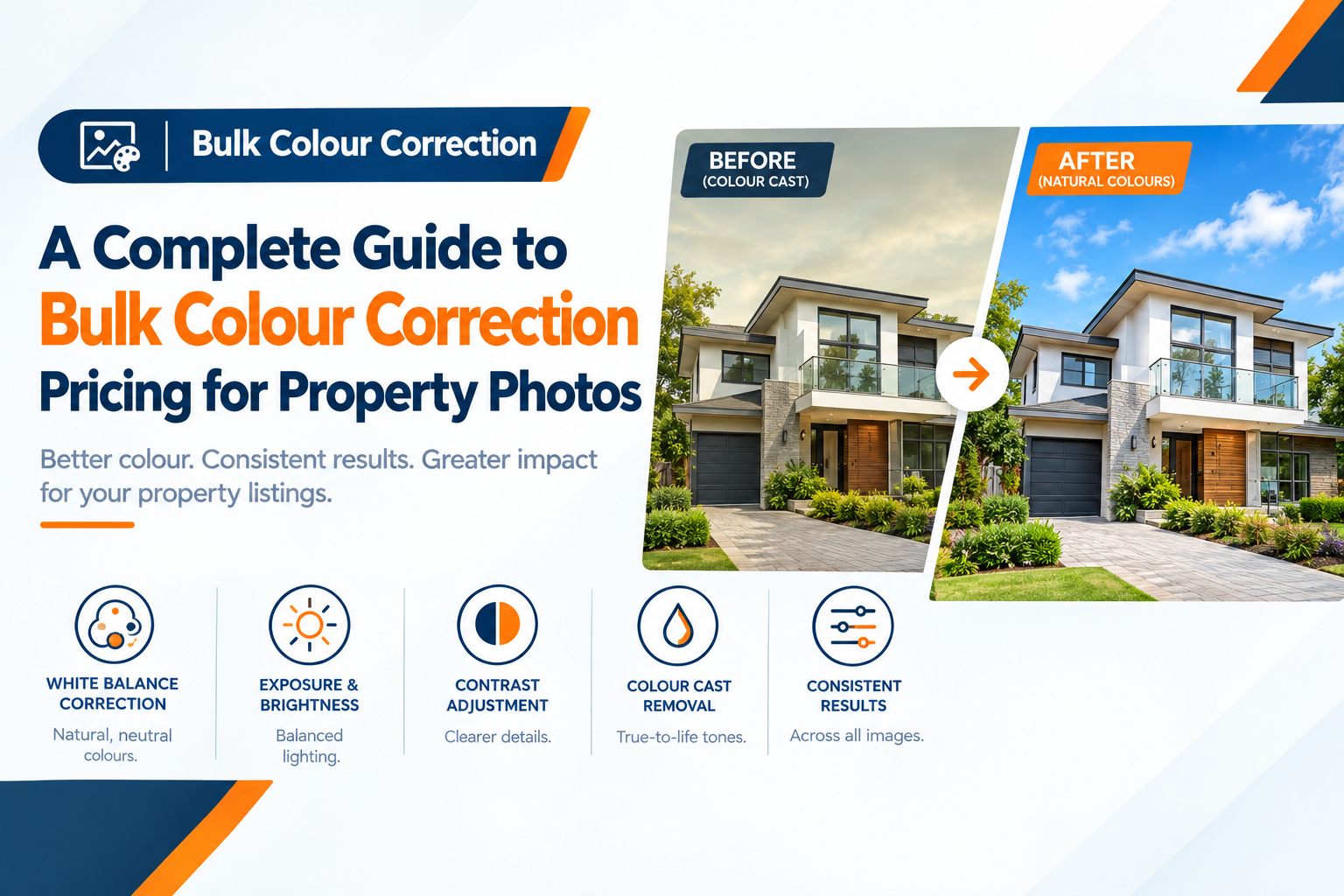
Colour correction is not simply about making photographs brighter or more colourful. Different images may have different white-balance issues, exposure levels, colour casts, lighting conditions, and camera characteristics. A consistent editing process is therefore needed to make a property listing look visually coherent.
The cost of bulk colour correction also depends on more than image count. Correction complexity, file quality, RAW or JPEG formats, mixed lighting, turnaround requirements, quality control, revisions, and the level of manual involvement can all affect the final project cost.
This guide explains how bulk colour correction pricing is generally calculated, what agencies should consider before requesting a quotation, and how to build a scalable correction workflow without sacrificing consistency.
1. What Is Bulk Colour Correction?
Bulk colour correction is the process of correcting the colour, tone, exposure, white balance, and related visual characteristics of a large number of photographs through a structured editing workflow.
For property photography, this may include adjustments to:
- White balance
- Colour temperature
- Tint
- Exposure
- Brightness
- Contrast
- Highlights
- Shadows
- Saturation
- Vibrance
- Hue
- HSL values
- RGB channels
- Curves and levels
The objective is generally to produce natural-looking and visually consistent photographs that are suitable for property listings and marketing.
Bulk correction is particularly useful when agencies need similar editing standards applied across multiple properties.
2. Why Agencies Need Bulk Colour Correction
Property photography can be affected by different lighting conditions.
For example, an interior photographed under warm artificial lighting may appear yellow or orange. Another room photographed under cooler lighting may have a blue cast.
If these images are placed together in the same property listing without correction, the overall presentation may feel inconsistent.
Bulk colour correction helps agencies establish a repeatable editing standard.
It can be used for:
- Residential property listings
- Commercial real estate
- New developments
- Vacation rentals
- Property portfolios
- Broker marketing campaigns
- Real estate brochures
- Website listings
- Digital advertising
For high-volume businesses, consistency becomes particularly important because the editing standard needs to remain stable across many images and properties.
3. How Bulk Colour Correction Pricing Is Usually Calculated
A provider may structure bulk colour correction pricing in several ways.
Per-Image Pricing
The provider charges according to the number of images edited.
This approach can be easy to understand when the photographs have relatively similar correction requirements.
However, 100 simple images and 100 difficult images may not represent the same amount of editing work.
Volume-Based Pricing
Larger image batches may be assessed according to the overall workload.
An agency processing hundreds of images regularly may require a different production arrangement from a business submitting a small one-time order.
Package Pricing
Some businesses may prefer a defined package for recurring workloads.
This can be useful when monthly image volumes are relatively predictable.
Complexity-Based Pricing
The level of correction may also influence the project quotation.
A photograph requiring basic exposure and white-balance adjustments is different from one requiring detailed mixed-light correction and colour balancing.
For this reason, agencies should provide sample photographs when requesting a bulk quotation.
4. Main Factors That Affect the Cost
Several factors can influence the cost of a bulk colour correction project.
Image Volume
The number of photographs directly affects the total production workload.
A project containing 50 images is different from one containing 500 or 1,000 images.
However, volume should always be considered together with correction complexity.
Correction Complexity
Some images require only minor adjustments.
Others may require more detailed work involving:
- Strong colour casts
- Mixed lighting
- Incorrect white balance
- Uneven exposure
- Difficult interior lighting
- HDR inconsistencies
- Multiple colour problems
The more complex the correction, the more editing attention may be required.
File Type
RAW files can provide greater editing flexibility than heavily compressed JPEG files.
The available image information can therefore influence the editing workflow.
Agencies should tell their provider whether they are submitting RAW, TIFF, JPEG, or other formats.
Image Quality
Low-resolution or heavily compressed images may limit how precisely colour and tonal adjustments can be made.
Higher-quality source files generally provide more information for professional correction.
Turnaround
Standard turnaround and urgent delivery may require different production planning.
A large project with a short deadline can require additional resources.
Quality Control
Agencies may require every image to be reviewed manually before delivery.
This additional quality-control step should be considered when evaluating the overall workflow.
Revisions
The number and type of revision cycles can also affect project workload.
Clear editing instructions can help reduce unnecessary revisions.
5. Image Volume and Per-Image Pricing
Image volume is one of the most visible factors in bulk editing, but it should not be treated as the only pricing variable.
Consider an agency processing:
- 50 images
- 100 images
- 500 images
- 1,000 images
The total workload increases as the image count increases.
But imagine two 500-image projects.
Project A
Most images require:
- Minor white-balance correction
- Small exposure adjustments
- Basic contrast balancing
Project B
The images contain:
- Mixed artificial and natural lighting
- Strong yellow or blue colour casts
- Uneven exposure
- Difficult interior lighting
- Different camera sources
Both projects contain 500 photographs, but the correction workload may be very different.
This is why agencies should discuss both volume and complexity before accepting a per-image quotation.
6. Basic Correction vs Advanced Correction
Not every property photograph needs the same level of colour work.
Basic Colour Correction
Basic correction may include:
- White-balance adjustment
- Exposure correction
- Brightness
- Contrast
- Highlights
- Shadows
- Minor saturation adjustments
This is generally focused on bringing the image closer to a natural and balanced appearance.
Advanced Correction
More advanced correction may involve:
- Strong colour cast removal
- Mixed-light correction
- Detailed HSL adjustments
- RGB balancing
- Curves and levels
- Specific colour matching
- HDR balancing
- Difficult interior lighting
The distinction matters when estimating the workload of a large batch.
An agency should avoid assuming that every photograph can be processed with the same preset or automated adjustment.
7. White Balance and Colour Cast Removal
White balance is particularly important in property photography.
A room illuminated by warm tungsten lighting can produce a yellow or orange appearance.
Fluorescent lighting can introduce different colour characteristics, while certain combinations of natural and artificial light can create uneven colour across the same room.
Colour cast removal aims to correct these unwanted colour shifts.
The editing process may involve adjusting:
- Colour temperature
- Tint
- Hue
- Saturation
- RGB channels
- Highlights
- Shadows
For example, a white wall should generally appear neutral rather than noticeably yellow, green, or blue unless that colour is intentionally part of the property's design.
Bulk white-balance correction can therefore be an important part of maintaining consistent property listing photography.
8. Colour Grading for Property Photography
Colour correction and colour grading are related but different processes.
Colour Correction
The primary goal is to correct unwanted colour and tonal problems.
Examples include:
- Incorrect white balance
- Colour casts
- Exposure problems
- Uneven contrast
Colour Grading
Colour grading involves creating a more deliberate visual appearance through broader colour and tonal decisions.
For real estate photography, the goal is generally not to create a dramatic cinematic appearance.
Instead, grading may be used carefully to establish consistency across a property marketing campaign.
Agencies should therefore clarify whether they require basic correction, colour cast removal, or more advanced colour grading before requesting a quotation.
9. Mixed Lighting and Difficult Images
Mixed lighting is one of the common challenges in interior property photography.
A single room may contain:
- Daylight from windows
- Warm ceiling lights
- Decorative lamps
- Reflected light
- Different artificial light sources
This can produce different colour temperatures within the same photograph.
Simply applying a global temperature adjustment may not correct every area.
More detailed correction may be required to balance different parts of the image while keeping the final result natural.
These photographs can therefore require more attention than straightforward images photographed under consistent lighting.
10. AI-Assisted vs Professional Manual Correction
AI-assisted editing can help process large batches of images efficiently.
Automated tools can identify common colour and exposure issues and apply adjustments across multiple photographs.
This can be useful for repetitive workflows.
However, automated correction may not always understand the intended appearance of every property photograph.
For example, an AI system may interpret warm interior lighting as an unwanted colour cast even when the warmth is part of the actual environment.
Professional manual correction can provide additional control over difficult images.
A practical workflow may therefore combine:
AI-assisted processing → professional review → manual correction where required → final quality assurance
The appropriate balance depends on image volume, correction complexity, quality expectations, and turnaround requirements.
There is no single workflow that is appropriate for every agency.
11. Turnaround Time and Rush Projects
For real estate businesses, turnaround time can be an important operational consideration.
Property photographs may be required for:
- New listings
- Website updates
- Advertising campaigns
- Property launches
- Brochures
- Social media campaigns
- Rental listings
An agency handling hundreds of images may therefore need a predictable editing schedule.
Standard projects can be planned according to normal production capacity.
Rush projects may require priority processing and additional production resources.
If urgent delivery is a regular requirement, agencies should discuss this with the provider before establishing a recurring workflow.
12. Quality Control and Consistency Across Large Batches
Bulk colour correction is not only about applying adjustments quickly.
Consistency matters.
If ten photographs of the same property have noticeably different colour temperatures, the listing can appear visually inconsistent.
Quality control should check areas such as:
- White balance
- Colour temperature
- Exposure
- Contrast
- Saturation
- Interior colours
- Exterior colours
- Natural-looking whites
- Consistency between photographs
- Unwanted colour shifts
For larger projects, image matching can also be useful.
The objective is to make photographs from the same property or campaign feel like part of the same visual set.
13. Revisions and Correction Policies
Revisions should be discussed before starting a high-volume project.
For a small batch, correcting a few images may be relatively simple.
For hundreds of images, unclear revision requirements can create significant additional workload.
Agencies should clarify:
- How revisions are requested
- Whether revisions are included
- How revision feedback is communicated
- How batch-wide corrections are handled
- Whether revised images maintain the same editing standard
- How final approval is provided
A clear revision workflow helps both the agency and the editing provider manage large projects more efficiently.
14. How to Estimate a Bulk Colour Correction Budget
Agencies can create an initial workload estimate without assuming a fixed market price.
Start by dividing the photographs into correction categories.
Correction Level
Typical Requirement
Relative Workload
Basic
White balance, exposure, minor contrast
Lower
Standard
Colour cast, exposure and tonal balancing
Moderate
Advanced
Mixed lighting, detailed colour correction
Higher
Complex
Difficult colour conditions, detailed matching
Highest
Then estimate the number of images in each category.
For example:
100-image project
- 60 basic
- 30 standard
- 10 advanced
Or:
500-image project
- 300 basic
- 150 standard
- 50 advanced
The provider can then review representative photographs from each category and determine the appropriate project quotation.
This approach is more useful than multiplying every image by an assumed universal rate.
15. What Agencies Should Ask a Service Provider
Before choosing a bulk colour correction service, agencies should ask several practical questions.
Pricing
- Is pricing based on per-image, volume, package, or complexity?
- Is there a minimum order?
- How are complex images handled?
- Does the quotation change for recurring monthly volumes?
Editing
- Do you provide white-balance correction?
- Can you handle colour cast removal?
- Do you support RAW files?
- Can you process HDR property photographs?
- Is advanced colour grading available?
AI and Manual Editing
- Is AI-assisted correction part of the workflow?
- Are automated results manually reviewed?
- How are difficult images handled?
- Can manual corrections be applied when automation is insufficient?
Quality Control
- How is consistency checked?
- Are images reviewed before delivery?
- How are colour mismatches between photographs handled?
Turnaround
- What is the standard turnaround?
- Can large batches be scheduled?
- Is rush processing available?
Revisions
- How are revision requests submitted?
- How are large-scale corrections managed?
- Is there a defined approval process?
16. How to Reduce Unnecessary Editing Costs
Agencies can improve efficiency by making their requirements clear before production begins.
Submit Good-Quality Source Files
Higher-quality images generally provide more useful information for correction.
Define the Desired Look
Tell the provider whether the goal is:
- Natural and neutral
- Bright and clean
- Warm
- Consistent with an existing listing style
Clear expectations can reduce revisions.
Provide Reference Images
If an agency already has an approved editing style, reference photographs can help establish the desired standard.
Separate Complex Images
Identifying difficult photographs early can help the provider plan the workflow.
Use Consistent Photography Practices
Where possible, maintaining similar camera and lighting practices across property shoots can reduce correction differences between images.
Avoid Unnecessary Colour Grading
If the objective is accurate property presentation, extensive grading may not be necessary.
The editing should match the property's marketing requirements rather than adding unnecessary effects.
17. Choosing a Long-Term Colour Correction Partner
For agencies processing property photographs regularly, the editing provider becomes part of the production workflow.
The right partner should be able to support:
- Bulk colour correction
- White-balance correction
- Colour cast removal
- Consistent output
- AI-assisted workflows
- Professional manual correction
- Quality assurance
- Revision management
- Recurring workloads
- Flexible image volumes
A useful way to evaluate a provider is to start with representative sample photographs.
Include different types of images:
- Bright interiors
- Dark interiors
- Mixed lighting
- Exterior photographs
- Strong colour casts
- HDR images
- Different camera sources
This allows the agency to evaluate how the provider handles different correction requirements before moving to larger recurring batches.
For businesses operating across markets such as Chennai, Tamil Nadu, South India, Dubai, or the wider UAE property sector, the ability to communicate requirements and maintain consistent output across recurring projects can be an important part of the workflow.
18. FAQs
How much does bulk colour correction cost?
Bulk colour correction does not have one universal cost. Pricing can depend on image volume, correction complexity, file quality, turnaround, quality-control requirements, and revisions.
How is bulk colour correction pricing calculated?
Pricing may be based on per-image rates, volume-based arrangements, packages, or the complexity of the correction required. Agencies should provide representative images when requesting a quotation.
What is the difference between colour correction and colour grading?
Colour correction focuses on fixing issues such as white balance, exposure, colour casts, and tonal inconsistencies. Colour grading is a broader creative process that shapes the overall colour and visual appearance.
What is colour cast removal?
Colour cast removal corrects an unwanted overall colour tint in an image, such as excessive yellow, orange, blue, or green.
Why is white balance important in real estate photography?
Incorrect white balance can make walls, furniture, flooring, and other property features appear different from their natural colours. Correcting white balance helps create a more balanced and consistent presentation.
Can AI handle bulk colour correction?
AI-assisted tools can help automate repetitive colour adjustments across large batches. However, difficult images may still require professional review and manual correction.
Is manual colour correction better than AI?
The appropriate workflow depends on the image volume, correction complexity, quality requirements, and turnaround expectations. AI can assist with repetitive tasks, while manual correction can provide additional control for difficult images.
How much does colour correction cost for 100 property photos?
The cost depends on the correction requirements of the 100 images. A batch requiring basic white-balance and exposure adjustments may involve a different workload from images with mixed lighting and strong colour casts.
How much does bulk colour correction cost for 500 images?
A 500-image project should be evaluated according to image complexity, file quality, correction requirements, turnaround, and quality-control expectations rather than assuming one fixed price.
Can you correct RAW property photographs?
RAW files can provide greater flexibility for professional colour and exposure adjustments. Agencies should confirm supported RAW formats with their editing provider before starting a large project.
How can agencies maintain colour consistency across multiple properties?
Agencies can establish editing guidelines, provide reference images, use consistent correction standards, and work with a structured quality-control process.
What should an agency provide when requesting a bulk quotation?
Provide the approximate image volume, sample photographs, file format, correction requirements, expected turnaround, preferred output format, and any reference images showing the desired result.
19. Conclusion
Bulk colour correction is primarily a workflow and consistency challenge for agencies managing large volumes of property photographs.
The total cost depends on more than the number of images. Correction complexity, image quality, file type, lighting conditions, white balance, colour casts, turnaround, revisions, and quality control can all influence the amount of work required.
Basic colour correction may involve straightforward adjustments to white balance, exposure, contrast, highlights, and shadows. More difficult photographs may require detailed colour cast removal, mixed-light correction, HSL adjustments, RGB balancing, or manual intervention.
AI-assisted tools can support high-volume workflows, particularly for repetitive corrections, while professional review can help identify and correct images that require additional attention.
For agencies, the most practical way to estimate a project is to provide representative images, define the desired editing standard, specify the image volume and turnaround requirements, and request a project-specific quotation.
A scalable bulk colour correction service should ultimately provide more than image processing. It should support predictable production, consistent property photography, clear revisions, and quality control across recurring workloads.
20. Streamline Your Property Photo Workflow with Professional Bulk Colour Correction from Voxelhaus Consultancy
If your agency manages large volumes of property photographs, Voxelhaus Consultancy can support structured bulk colour correction workflows for property marketing and real estate listings.
Share your:
- Approximate image volume
- File format
- Correction requirements
- Sample photographs
- Expected turnaround
- Quality expectations
- Recurring workload requirements
The workflow can include bulk property photo colour correction, white-balance correction, colour cast removal, AI-assisted processing, professional quality control, and consistency checks across large batches.
Whether you are managing 50, 100, 500, or 1,000+ property images, the editing requirements can be assessed according to the actual workload rather than relying on an assumed universal price.
Send your property photo requirements to Voxelhaus Consultancy to discuss a suitable bulk colour correction workflow and receive a project-specific quotation.