Introduction
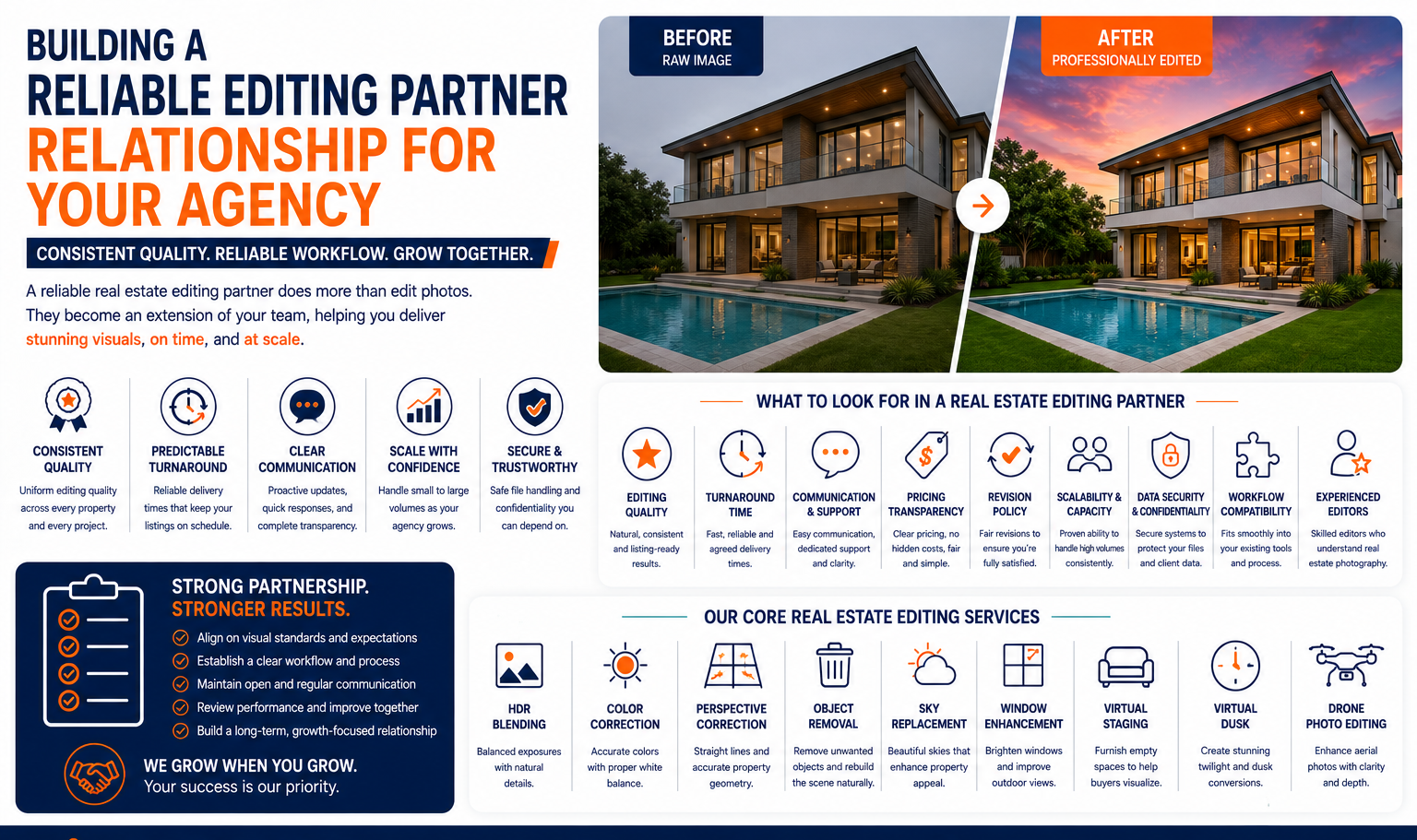
For a growing real estate agency, professional property photography is only one part of the listing workflow. Once photographs are captured, they need to be processed, corrected, enhanced, organized, and delivered before the property goes live. When editing becomes inconsistent or delayed, the entire marketing process can slow down.
This is why choosing dependable real estate editing services is an important operational decision for agency owners and property marketing teams.
A reliable editing partner should do more than simply edit photographs. They should understand your visual standards, follow your workflow, maintain consistent quality, communicate clearly, meet agreed deadlines, and handle increasing image volumes as your agency grows.
For example, an agency may initially process 50–100 property images per month. As listings increase, that volume can quickly become several hundred or even thousands of images. An editing provider that works well for a small workload may not necessarily have the systems required to support a larger operation.
The right relationship therefore needs to be treated as a long-term business partnership rather than a simple transaction.
At Voxelhaus Consultancy, we understand that real estate agencies need dependable post-production support that fits into their existing marketing workflow. From HDR enhancement and color correction to object removal, sky replacement, virtual staging, drone editing, and listing-ready image delivery, the goal is to provide consistent visual quality while helping agencies manage their workloads efficiently.
This guide explains the most important factors agencies should consider when building a reliable relationship with a professional real estate editing partner.
What Makes a Real Estate Editing Partner Reliable?
Reliability is not determined by one factor. A provider may produce excellent images but still be difficult to work with if deadlines are regularly missed or communication is poor.
A dependable editing partner should provide a combination of:
- Consistent editing quality
- Predictable turnaround times
- Clear communication
- Transparent pricing
- Well-defined revision policies
- Scalable production capacity
- Quality-control procedures
- Secure file handling
- Workflow compatibility
- Experienced editors
The objective is to create a system where your agency can send photographs with confidence and receive completed images according to an agreed process.
1. Evaluate Editing Quality Before Long-Term Commitment
Quality should be the first consideration when selecting real estate editing services.
A provider should demonstrate that they understand real estate photography rather than simply applying generic photo filters.
Professional property editing may involve:
- HDR blending
- Exposure correction
- White balance correction
- Color correction
- Perspective correction
- Vertical line correction
- Lens distortion correction
- Sky replacement
- Object removal
- Window brightening
- Window view replacement
- Lawn enhancement
- Virtual dusk conversion
- Image sharpening
- Noise reduction
The goal is not to make every image look heavily edited. Instead, professional post-production should make the property look attractive while preserving a realistic representation of the space.
Ask for a Test Project
Before committing to a long-term arrangement, consider sending a small sample batch.
Evaluate:
Image quality: Are details preserved?
Color: Are walls, floors, furniture, and exterior materials represented naturally?
Consistency: Do multiple photographs from the same property have a similar visual appearance?
Perspective: Are vertical architectural lines straight?
Retouching: Are removed objects replaced naturally?
Realism: Does the final photograph still accurately represent the property?
A test project can reveal more about a provider's capabilities than a portfolio alone.
2. Consistency Matters More Than One Excellent Image
One outstanding edited photograph does not guarantee a reliable editing relationship.
Real estate agencies typically need entire sets of photographs edited consistently.
For example, a property may contain:
- Exterior photographs
- Living room images
- Bedrooms
- Kitchen photographs
- Bathrooms
- Hallways
- Balconies
- Gardens
- Aerial images
Each photograph may have different lighting conditions. Nevertheless, the final set should feel like one coherent collection.
Why Consistency Matters
Inconsistent editing can create problems such as:
- Different color temperatures
- Uneven brightness
- Excessive saturation
- Different contrast levels
- Inconsistent sky appearance
- Varying sharpness
- Different retouching styles
This can make an agency's listings look unprofessional.
A strong editing partner should develop a repeatable workflow that maintains your preferred visual style across projects.
3. Turnaround Time Should Match Your Listing Workflow
Speed is another critical factor for real estate agencies.
Property marketing often operates under tight deadlines. A property may need to be photographed in the morning, edited in the afternoon, and published the same day or the following morning.
A slow editing provider can therefore delay:
- Listing publication
- Property portal uploads
- Social media campaigns
- Email marketing
- Paid advertising
- Brochure production
- Property launches
When evaluating a fast turnaround real estate photo editing service online, do not focus only on the advertised delivery time.
Ask:
- What is the standard turnaround?
- Is same-day delivery available?
- How are urgent projects handled?
- Does turnaround change for bulk orders?
- Are weekends or holidays included?
- What happens if a deadline is missed?
A reliable provider should establish realistic turnaround commitments rather than promising unrealistic delivery times.
4. Communication Should Be Simple and Predictable
Good communication can significantly reduce operational friction.
Agency teams should not have to repeatedly explain the same requirements for every project.
A professional editing partner should establish a clear communication process covering:
- Project instructions
- File submission
- Editing preferences
- Delivery notifications
- Revision requests
- Urgent requirements
- Quality concerns
- Project status
For larger agencies, assigning a dedicated point of contact can make communication even easier.
Create an Editing Brief
A standardized editing brief can include:
- Preferred brightness
- Color style
- HDR preference
- Sky replacement preferences
- Object removal rules
- Window treatment
- Virtual staging requirements
- Dusk editing preferences
- Export specifications
- File naming conventions
Once these preferences are documented, your team does not need to repeat them for every listing.
5. Establish a Clear Revision Process
Even experienced editors may occasionally misunderstand a creative preference.
That is why revisions should be discussed before starting a long-term partnership.
Ask your provider:
- How many revisions are included?
- Are minor corrections free?
- How should revision requests be submitted?
- How quickly are revisions completed?
- Are major creative changes charged separately?
A transparent revision system prevents misunderstandings and unexpected costs.
Example
Suppose your agency prefers neutral interior colors but receives images with an overly warm tone.
Instead of starting a completely new order, your team should be able to request a correction through an established revision workflow.
Over time, these recurring preferences should be incorporated into the editing guidelines to reduce future revisions.
6. Look for Scalable Bulk Editing Capabilities
A provider may perform excellent work for ten photographs but struggle when asked to process 500.
For agencies, scalability is therefore essential.
A reliable editing partner should be able to manage:
- Single-property orders
- Multi-property batches
- Large image volumes
- Recurring weekly work
- Recurring monthly work
- Seasonal increases
- Developer project portfolios
Why Scalability Matters
Imagine an agency manages 20 listings per month today but expects to manage 60 listings next year.
If the editing provider cannot increase capacity, the agency may eventually face:
- Longer turnaround times
- Quality inconsistencies
- Missed deadlines
- Communication problems
- Workflow bottlenecks
Choosing a provider with scalable production capabilities from the beginning makes future growth easier.
7. Understand Pricing Before Increasing Your Order Volume
Pricing should be transparent and easy to understand.
Different providers may charge according to:
- Number of images
- Editing complexity
- Property type
- Service type
- Turnaround time
- Monthly volume
- Bulk order size
For example, basic HDR editing may have a different price from advanced object removal, virtual staging, or 360° virtual tour enhancement.
Agencies should ask whether pricing includes:
- Basic corrections
- Advanced retouching
- Revisions
- Urgent delivery
- Bulk processing
- Special requests
- Additional file formats
A clear pricing structure makes it easier to calculate the actual cost of outsourcing.
8. Check Whether the Provider Offers the Services You Will Need Later
Your agency's requirements may expand over time.
Initially, you may only need basic interior and exterior editing. Later, your marketing team may require:
- Drone photo editing
- Virtual staging
- Sky replacement
- Object removal
- Window view replacement
- Virtual dusk conversion
- 360° virtual tour editing
- Floor plan visualization
Working with one experienced partner for multiple services can simplify your workflow.
Instead of coordinating with several vendors, your agency can maintain one established production process.
At Voxelhaus Consultancy, our real estate post-production workflow supports multiple property marketing requirements, allowing agencies to expand their editing needs without rebuilding their vendor network from scratch.
9. Quality Control Should Be Part of the Workflow
A professional editing company should have a quality-control process before delivering completed images.
Quality checks may include:
Technical Review
- Correct resolution
- Correct file format
- Proper cropping
- No compression issues
- No obvious artifacts
Visual Review
- Natural colors
- Correct exposure
- Consistent brightness
- Realistic shadows
- Clean object removal
- Accurate perspective
Property Accuracy
- No important architectural features accidentally removed
- No unrealistic modifications
- No misleading alterations
- Property details remain recognizable
Quality control reduces the amount of time your agency needs to spend checking every delivered image.
10. Protect Your Agency's Visual Style
Your agency's listing images are part of your brand identity.
If one property uses bright, warm images while another uses dark, heavily saturated images, the overall portfolio may appear inconsistent.
A long-term editing partner should therefore understand your brand requirements.
Consider creating a visual style guide covering:
- Color temperature
- Exposure
- Contrast
- Saturation
- HDR intensity
- Sky preferences
- Interior brightness
- Exterior appearance
- Dusk conversion style
- Retouching limits
The more clearly these standards are documented, the easier it becomes for editors to reproduce your preferred appearance.
How to Build an Efficient Agency-to-Editor Workflow
Finding a good editor is only the first step. The next step is creating a workflow that makes the partnership efficient.
A basic workflow can look like this:
Photography → File Upload → Editing Instructions → Editing → Quality Control → Delivery → Agency Review → Revisions → Final Publishing
Every stage should have clear responsibilities.
For example, the agency should provide:
- Correct source photographs
- Property name or project ID
- Editing requirements
- Special instructions
- Delivery requirements
The editing team should provide:
- Confirmation of received files
- Status updates when necessary
- Edited images
- Quality-checked files
- Revision support
A structured process reduces unnecessary back-and-forth.
File Transfer and Project Management Matter
Large real estate photography projects can involve hundreds of high-resolution files.
Email attachments may not be practical for this type of workflow. Agencies should use an organized file-transfer process that allows large batches to be uploaded and downloaded efficiently.
A good system should make it easy to identify:
- Client
- Property
- Project
- Date
- Image batch
- Editing instructions
- Final files
Use Consistent File Naming
For example:
Client_Property_Room_001.jpg
or
ProjectName_Exterior_01.jpg
Consistent naming makes it easier for both the agency and editing team to manage large projects.
A professional listing ready real estate photo delivery service should fit into this type of organized process.
How to Handle Urgent and High-Volume Projects
Real estate agencies sometimes experience sudden increases in workload.
A developer may launch several properties at once. A brokerage may receive multiple new listings in a single day. A photographer may need hundreds of images processed after a busy week.
Before choosing a partner, ask how they handle peak workloads.
Important questions include:
- Can they increase production capacity?
- Is there an urgent editing process?
- Can multiple properties be processed simultaneously?
- Is there a dedicated team for recurring accounts?
- How are priority orders identified?
- Does urgent work affect standard projects?
The objective is not simply to find the fastest editor. It is to find an editing partner with a process that remains stable when workload increases.
Measuring Your Editing Partner's Performance
A long-term relationship should be evaluated using measurable indicators.
Instead of relying only on general impressions, agencies can track:
1. Turnaround Performance
Measure how consistently projects are delivered within the agreed timeframe.
2. Revision Rate
A high number of revisions may indicate unclear instructions or inconsistent editing.
3. Quality Consistency
Review whether images maintain the same standard across different projects and editors.
4. Communication
Track how quickly questions, corrections, and urgent requests are handled.
5. Scalability
Evaluate whether the provider can handle increased order volume without sacrificing quality.
6. Cost Predictability
Check whether invoices consistently match the agreed pricing structure.
These measurements help agencies determine whether their real estate photo editing service is genuinely supporting business operations.
Common Mistakes When Outsourcing Real Estate Photo Editing
Outsourcing can save time and resources, but poor planning can create new problems.
Choosing Only Based on Price
The cheapest provider may not offer the consistency, communication, or quality required for professional property marketing.
Not Testing the Service
Starting with a large order without a test project can create unnecessary risk.
Giving Unclear Instructions
Editors cannot consistently reproduce a style that has never been clearly defined.
Ignoring Revision Policies
A low initial price can become expensive if every correction is treated as an additional service.
Failing to Plan for Growth
A provider may handle your current workload but struggle when your listing volume increases.
Using Multiple Providers Without Standards
Using several editors without a shared visual style can make your property portfolio look inconsistent.
Not Having Quality Control
Even good editors can make mistakes. A final review process is essential.
How to Maintain a Long-Term Editing Partnership
A successful relationship requires cooperation from both sides.
Agencies should provide consistent instructions and constructive feedback. Editing teams should use that feedback to improve future projects.
Over time, the partnership can become more efficient when both sides understand:
- Editing preferences
- Typical property types
- Common corrections
- Delivery requirements
- Brand standards
- Peak periods
- Urgent workflows
Regularly reviewing the process can also identify opportunities for improvement.
For example, if the agency repeatedly requests the same correction, that requirement should be added to the standard editing brief.
This turns individual feedback into a permanent workflow improvement.
Practical Checklist for Choosing a Real Estate Editing Partner
Before hiring a professional editing team, use the following checklist.
Quality
☐ Does the provider specialize in real estate imagery?
☐ Can they demonstrate consistent results?
☐ Do they understand HDR blending and architectural photography?
☐ Is the editing realistic rather than excessive?
Turnaround
☐ Are delivery timelines clearly defined?
☐ Can they support urgent projects?
☐ Can they handle bulk orders?
Communication
☐ Is there a clear communication channel?
☐ Can you provide detailed editing instructions?
☐ Is there a dedicated contact for larger accounts?
Revisions
☐ Is the revision policy clear?
☐ Are minor corrections handled efficiently?
☐ Are additional charges explained in advance?
Scalability
☐ Can the provider handle increasing image volumes?
☐ Can they process multiple properties?
☐ Do they have a structured production workflow?
Pricing
☐ Is pricing transparent?
☐ Are bulk rates available?
☐ Are additional services clearly priced?
Services
☐ Do they offer the editing services you currently need?
☐ Can they support future requirements such as virtual staging, drone editing, or 360° services?
Quality Control
☐ Is every project reviewed before delivery?
☐ Are technical and visual quality checks performed?
Workflow
☐ Is file transfer convenient?
☐ Are files organized clearly?
☐ Does the provider fit into your existing agency process?
If a provider performs well across most of these areas, they are more likely to become a dependable long-term partner.
Why a Reliable Editing Partner Becomes a Business Advantage
The value of outsourcing professional post-production goes beyond improving individual photographs.
A dependable editing partner can help an agency create a more efficient property marketing operation.
Instead of spending internal resources on repetitive post-production tasks, the agency can focus on:
- Acquiring new listings
- Managing clients
- Marketing properties
- Generating leads
- Supporting sales teams
- Building its brand
- Expanding into new markets
Professional editing also helps create a consistent visual presentation across property portals, websites, brochures, social media, paid campaigns, and other marketing channels.
For agencies operating across locations such as Mumbai, Chennai, Hyderabad, Bengaluru, or other markets, a centralized online editing workflow can also make it easier to manage property imagery regardless of where the photography takes place.
The same principle applies to agencies and property businesses working across India, the UAE, South Asia, and Gulf markets.
Frequently Asked Questions
What are real estate editing services?
Real estate editing services involve professional post-production of property photographs to improve exposure, color, perspective, detail, and overall presentation while maintaining a realistic representation of the property.
Services may include HDR blending, color correction, object removal, sky replacement, window brightening, virtual staging, drone image editing, and other property photo enhancement techniques.
Why should real estate agencies outsource photo editing?
Outsourcing allows agencies to reduce the internal workload associated with repetitive post-production while maintaining a more consistent workflow.
It can be particularly useful when agencies manage large numbers of listings or need professional images delivered within defined deadlines.
How do I choose a reliable real estate photo editing company?
Evaluate the provider based on editing quality, consistency, turnaround time, communication, revision policies, pricing transparency, scalability, quality control, and workflow compatibility.
A small test project is also useful before entering into a long-term relationship.
What should I include in an editing brief?
An editing brief can include your preferred brightness, color temperature, HDR style, sky replacement preferences, window treatment, object removal rules, export specifications, file naming conventions, and other brand-specific requirements.
Can professional editors handle bulk property images?
Yes. Many professional editing companies are structured to process bulk property images. However, agencies should confirm production capacity and quality-control procedures before committing to high-volume work.
Is virtual staging part of real estate photo editing?
Virtual staging is a specialized form of property image enhancement that digitally adds furniture and décor to an empty room. It can be offered alongside traditional real estate photo editing, depending on the provider.
Can drone and aerial property photographs be edited?
Yes. Real estate drone aerial photo editing can include exposure correction, color enhancement, perspective adjustments, image cleanup, and other post-production requirements appropriate for aerial photography.
How can agencies maintain consistent image quality across different listings?
The best approach is to establish a visual style guide and provide consistent editing instructions. Working with a dedicated or experienced editing team can also reduce variations between projects.
What is the advantage of working with one long-term editing partner?
A long-term partner becomes familiar with the agency's visual standards, workflow, property types, communication preferences, and recurring requirements. This can reduce repeated instructions and make the overall production process more efficient.
Can agencies outsource real estate photo editing online?
Yes. Online workflows allow agencies, photographers, developers, and property marketing teams to send photographs to professional editing teams regardless of their physical location.
This makes it possible to work with a real estate editing company serving UAE and South Asia, for example, without requiring the editing team to be located in the same city.
Conclusion
Building a reliable relationship with a real estate editing partner requires more than finding someone who can improve photographs.
Agencies need a partner that can consistently deliver quality, meet agreed timelines, communicate clearly, manage revisions, support bulk workloads, maintain brand standards, and adapt as the business grows.
The most important factors to evaluate are:
- Editing quality
- Visual consistency
- Turnaround time
- Communication
- Revision management
- Scalability
- Pricing transparency
- Service range
- Quality control
- Workflow compatibility
A strong partnership can turn real estate post-production from a recurring operational challenge into a predictable part of the property marketing process.
Whether you are a real estate agency, property developer, photographer, broker, or marketing team, investing in a structured editing workflow can help you deliver better listing visuals while allowing your internal team to focus on higher-value business activities.
At Voxelhaus Consultancy, we support property businesses with professional real estate photo editing and related post-production requirements, including interior and exterior enhancement, HDR processing, object removal, sky replacement, virtual staging, drone image editing, and other listing-focused visual services.
The goal is simple: create a dependable workflow where your property photographs are edited consistently, delivered efficiently, and prepared for professional marketing.
Build a Reliable Property Marketing Workflow with Voxelhaus Consultancy
Looking for a dependable partner for your property image post-production?
Voxelhaus Consultancy can support agencies, developers, photographers, brokers, and property marketing teams with scalable real estate editing services designed around quality, consistency, and workflow efficiency.
From individual property photographs to recurring bulk projects, a structured editing process can help your team reduce post-production workload and keep listings moving toward publication.
Explore a professional property photo editing workflow with Voxelhaus Consultancy and build a reliable post-production partnership for your growing real estate business.