Introduction
Selling a property for the first time comes with plenty of decisions. You need to prepare the property, arrange photography, write the listing description, choose the right marketing platforms, and make sure the photographs present the property clearly.
One thing many first-time sellers discover is that even a good property photograph can contain distracting objects.
A car may block part of a driveway. A rubbish bin may be visible beside the house. Personal belongings may make an otherwise attractive room look crowded. Power lines, signs, banners, wall stickers, or small pieces of debris may draw attention away from the property itself.
This is where object removal photo editing can help.
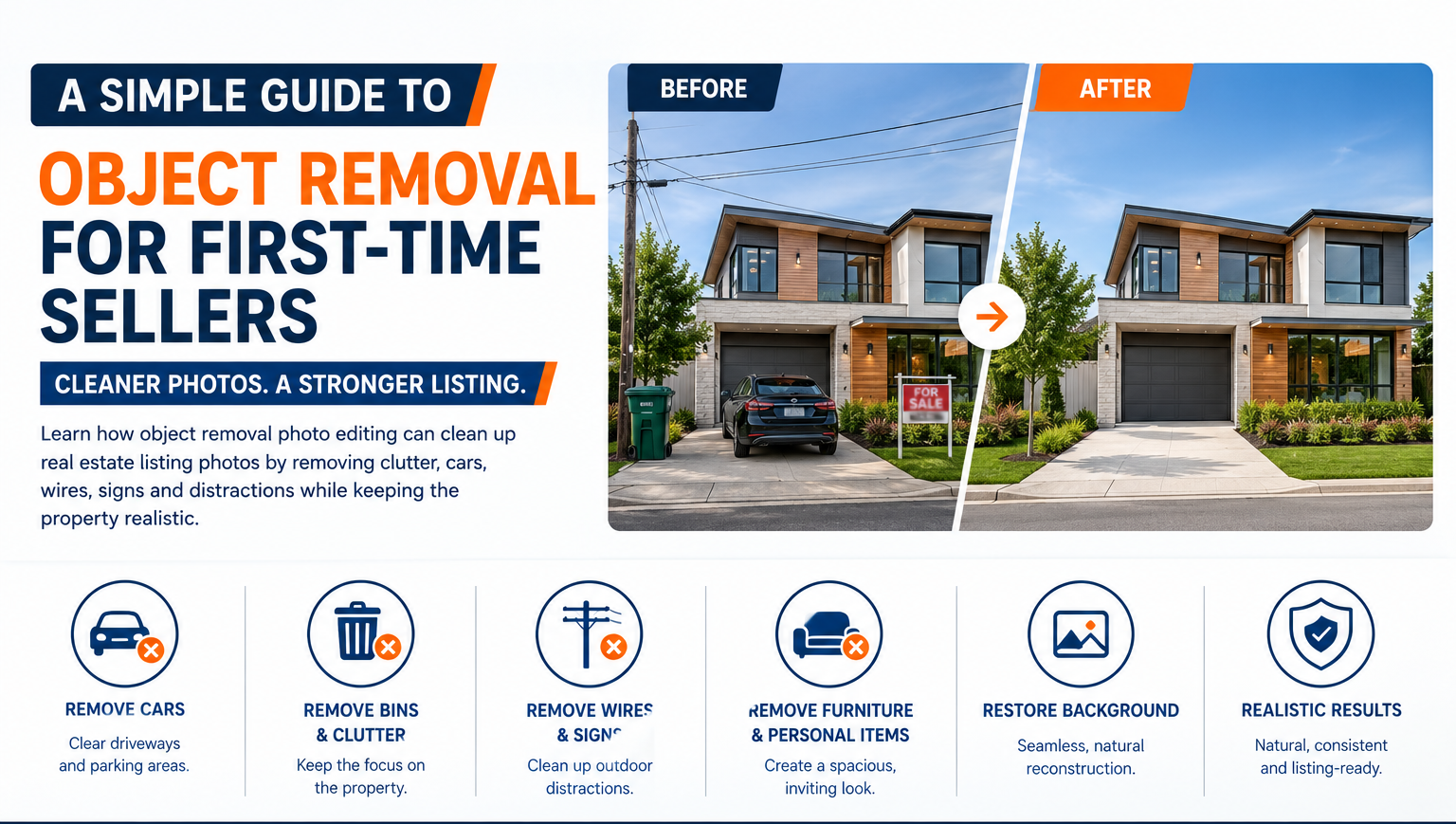
Object removal is the process of digitally removing unwanted or distracting elements from a photograph and reconstructing the area behind them so the image looks natural.
The important point is that object removal should be used to clean up the photograph, not misrepresent the property.
For a first-time seller, understanding what can be removed, what should remain, how AI-assisted editing works, and when professional editing is worthwhile can make the listing preparation process much easier.
This guide explains everything you need to know before requesting object removal for your property photographs.
1. What Is Object Removal Photo Editing?
Object removal is a form of digital image retouching where an unwanted element is removed from a photograph and the background is reconstructed.
Imagine taking an exterior photograph of your home.
There is a rubbish bin near the front entrance.
You want the property itself to be the focus of the image, so the bin can potentially be removed during post-production.
The editor does not simply erase the bin and leave an empty patch.
The area behind the bin needs to be recreated.
Depending on the background, this might involve reconstructing:
- Grass
- Concrete
- Brick
- Wall texture
- Flooring
- Plants
- Driveways
- Tiles
- Furniture
- Architectural surfaces
This is why professional object removal is more than simply pressing an "erase" button.
The final image needs to look as though the distracting object was never present.
2. Why Do Property Listing Photos Need Object Removal?
When buyers browse property listings, they usually scan photographs quickly.
Small distractions can compete with the property's important features.
For example, an exterior photograph may contain:
- A parked car
- Garbage bins
- Temporary signs
- Construction materials
- Wires
- People
- Photographic equipment
An interior photograph may contain:
- Boxes
- Clothes
- Toys
- Personal photographs
- Small appliances
- Unnecessary furniture
- Wall decorations
These objects may not be serious problems individually, but together they can make a listing look less organized.
A property photo cleanup service can help create a cleaner presentation.
The goal is not to make the property look completely empty or artificial.
The goal is to help buyers focus on the:
- Room layout
- Architecture
- Finishes
- Outdoor space
- Natural light
- Property features
rather than temporary distractions.
3. What Objects Can Be Removed From Real Estate Photos?
Many different types of unwanted objects can potentially be removed.
Interior Objects
Examples include:
- Boxes
- Bags
- Toys
- Clothes
- Small appliances
- Temporary furniture
- Personal belongings
- Wall stickers
- Decals
- Cables
- Small decorative distractions
Exterior Objects
Examples include:
- Cars
- Bins
- Temporary signs
- Banners
- Construction materials
- Small debris
- Garden equipment
- Temporary barriers
Background Distractions
Editors may also be able to remove:
- Photobombs
- People who accidentally appear in the frame
- Temporary objects
- Small distracting background elements
The difficulty depends heavily on what is behind the object.
Removing a small bin from a plain lawn may be relatively straightforward.
Removing a large vehicle covering part of a patterned driveway can require considerably more reconstruction.
4. Can Cars Be Removed From Property Photos?
Yes, cars can sometimes be removed from real estate photographs.
For example, imagine an exterior image where a vehicle is parked directly in front of the house.
If the car blocks an important part of the driveway or landscaping, an editor may be able to remove it.
However, vehicle removal can become complicated when the car covers:
- Driveway patterns
- Landscaping
- Steps
- Walls
- Garage doors
- Architectural features
- Reflections
- Shadows
The editor needs to reconstruct whatever is hidden behind the vehicle.
This is why remove car from driveway in property photo is not always a simple one-click process.
For difficult images, manual retouching and careful background reconstruction may be necessary.
5. Can Wires, Signs and Banners Be Removed?
Power lines, utility wires, signs, banners, and temporary advertising materials can sometimes create significant visual distractions in exterior photographs.
A wire crossing the sky can draw attention away from the building.
A temporary banner may cover part of a wall or fence.
A sign may distract from the property's entrance.
Professional editors can use techniques such as:
- Object selection
- Masking
- Cloning
- Healing
- AI-assisted removal
- Image inpainting
The complexity depends on the background.
Removing a wire against a plain sky is different from removing a wire crossing:
- Trees
- Brickwork
- Windows
- Roof tiles
- Detailed architecture
The more complicated the background, the more important quality control becomes.
6. Can Furniture and Personal Belongings Be Removed?
Yes, unwanted furniture and personal belongings can sometimes be removed from property photographs.
This can be particularly useful when preparing a property for sale.
Examples include:
- Excess chairs
- Temporary tables
- Boxes
- Toys
- Clothing
- Personal decorations
- Small appliances
- Unwanted furniture
However, sellers should think carefully before requesting complete furniture removal.
Furniture can help communicate:
- Room size
- Layout
- Function
- Scale
Removing everything from a room may make it difficult for buyers to understand how the space can be used.
If the objective is to show a genuinely vacant property, complete furniture removal may be appropriate.
If the property is occupied, selective background clutter removal for real estate photos may be more useful.
7. Can Yard, Pool and Driveway Clutter Be Cleaned Up?
Exterior spaces often contain temporary items that can distract from the property.
Examples include:
- Fallen branches
- Small pieces of debris
- Garden tools
- Buckets
- Temporary equipment
- Pool toys
- Cleaning materials
- Small unwanted objects
A professional editor may be able to clean up these areas while preserving the natural appearance of the yard or pool.
However, sellers should distinguish between temporary clutter and permanent property features.
For example:
Removing a temporary garden hose may be reasonable.
Removing a permanent retaining wall because it makes the garden look smaller would misrepresent the property.
The objective should always be visual cleanup rather than property alteration.
8. When Should an Object Be Removed?
A useful rule is:
Remove temporary or distracting elements that interfere with the presentation of the property, while keeping permanent or important property features visible.
An object may be suitable for removal when it is:
- Temporary
- Unwanted
- Distracting
- Accidentally captured
- Obstructing a marketing photograph
- Not relevant to understanding the property
For example:
Usually reasonable:
- Temporary rubbish bin
- Photobomber
- Small piece of debris
- Temporary sign
- Loose cables
- Personal clutter
Requires more consideration:
- Large furniture
- Vehicles
- Garden structures
- Permanent signs
- Fixtures
- Architectural elements
When uncertain, discuss the object with the editor before editing.
9. When Should an Object Stay in the Photograph?
Not everything that looks unattractive should be removed.
Some elements are part of the property and should remain.
Examples may include:
- Permanent structures
- Built-in furniture
- Fixed installations
- Permanent fencing
- Permanent landscaping
- Structural elements
- Neighbouring buildings
- Permanent access features
A listing photograph should help buyers understand the property accurately.
Removing permanent features simply because they are visually inconvenient can create an unrealistic impression.
This is especially important for first-time sellers who may be unfamiliar with professional property photo editing.
A good editor should not automatically remove everything requested without considering whether the edit could change the viewer's understanding of the property.
10. How Does AI Object Removal Work?
Modern image-editing software can use artificial intelligence to identify an unwanted object and generate replacement pixels for the selected area.
This is often referred to as AI image inpainting.
The basic process is:
Select object → Mask object → AI generates replacement → Review result → Refine → Export
Tools such as AI-assisted object removal and Generative Fill can be useful for simple and moderately complex edits.
For example, an AI tool may successfully remove a small object from a plain wall.
But AI does not always understand the property exactly as a human editor does.
It may generate:
- Incorrect textures
- Repeated patterns
- Strange architectural details
- Distorted edges
- Incorrect shadows
- Unnatural reflections
That is why AI-assisted editing should ideally be followed by human review.
11. AI-Assisted vs Professional Manual Object Removal
AI-assisted tools can be extremely useful, but professional editing involves more than selecting an object.
Factor
AI-Assisted Removal
Professional / Manual Editing
Simple objects
Often effective
Highly controllable
Complex backgrounds
May require refinement
Better control
Architectural edges
Can produce artifacts
Can be carefully reconstructed
Texture matching
Automated
Manually controlled
Shadows
May be inconsistent
Can be refined
Reflections
Can be difficult
More precise handling
Large objects
Results vary
Detailed reconstruction possible
Batch work
Fast
Structured and consistent
Quality control
Tool-dependent
Human review
Final refinement
May be needed
Included in professional workflow
The best approach is not necessarily AI versus humans.
A practical professional workflow can be:
AI-assisted processing → manual refinement → quality control → final delivery
This combines the speed of AI with the judgement of an experienced editor.
12. Why Background Reconstruction Matters
Object removal becomes difficult when the removed object covers an important part of the background.
Consider a car parked on a patterned driveway.
Once the car is removed, the editor may need to reconstruct:
- Driveway texture
- Pattern alignment
- Shadows
- Edges
- Perspective
- Landscaping
Similarly, removing a chair from a room may reveal flooring that was previously hidden.
The editor must make the new floor area match the surrounding floor.
This process is known as background reconstruction.
Professional editors may use:
- Clone tools
- Healing tools
- Image inpainting
- Generative Fill
- Manual painting
- Masking
- Texture sampling
The objective is to make the reconstructed area blend naturally into the original photograph.
13. Why Shadows, Reflections and Architectural Edges Matter
One of the easiest ways to identify poor object removal is to look at areas surrounding the removed object.
Shadows
Objects cast shadows.
If an object disappears but its shadow remains, the edit can look incomplete.
If the editor removes both object and shadow but reconstructs the area incorrectly, the result can also look unnatural.
Reflections
Glass, polished floors, mirrors, vehicles, and water can contain reflections.
Removing an object without considering its reflection can create an obvious editing artifact.
Architectural Edges
Walls, doors, windows, tiles, rooflines, and furniture often contain straight edges.
Poor reconstruction can cause:
- Bent lines
- Broken edges
- Repeated textures
- Distorted patterns
This is why professional real estate object removal for interior and exterior photos requires careful attention to surrounding details.
14. How Should Sellers Prepare Photos for an Editor?
You do not need to prepare your photographs perfectly before sending them.
However, a few details can make the process easier.
Send the highest-quality originals available
Avoid repeatedly compressed screenshots or heavily resized copies.
Identify the objects
Tell the editor exactly what you want removed.
For example:
“Please remove the black car from the driveway and the temporary banner near the entrance.”
This is clearer than:
“Please clean the image.”
Mention anything that must remain
For example:
“Keep the garden furniture and permanent wall fixtures.”
Provide multiple images when relevant
If the same area appears in several photographs, the additional images may help the editor understand the property.
Explain the intended use
Tell the editor whether the images are intended for:
- Property portals
- Website
- Brochure
- Social media
- Advertising
- Developer marketing
Clear instructions can reduce unnecessary revisions.
15. How to Review Object Removal Before Publishing
Before publishing your property listing, compare the edited image with the original.
You do not need advanced editing skills.
Simply inspect the photograph carefully.
Check the background
Does the area where the object was removed look natural?
Check textures
Look for:
- Repeated patterns
- Blurry areas
- Strange lines
- Texture mismatches
Check architecture
Look at:
- Walls
- Doors
- Windows
- Tiles
- Rooflines
- Fences
Make sure they have not been distorted.
Check shadows
Make sure the lighting still makes sense.
Check reflections
Look at:
- Glass
- Mirrors
- Water
- Polished floors
Check the overall photograph
Ask:
“Would someone viewing this image believe it naturally represents the property?”
If the answer is yes, the edit is likely doing its job.
16. What Makes Professional Object Removal Look Realistic?
Good object removal should be difficult to notice.
A professional edit should preserve:
- Natural texture
- Perspective
- Lighting
- Shadows
- Reflections
- Architectural lines
- Colour
- Material appearance
It should also maintain consistency across the property listing.
For example, if five photographs show the same living room, the editing should not make the room look noticeably different from one image to another.
This is especially important for professional property marketing.
The goal is not to create a "perfect" image.
The goal is to create a cleaner and more useful photograph.
17. Turnaround, Revisions and Multiple Photos
Object removal requirements can range from one small edit to extensive cleanup across an entire property.
Before placing an order, clarify:
- Number of photographs
- Objects to be removed
- Complexity
- Required output format
- Image resolution
- Expected turnaround
- Revision process
- Delivery method
A single simple object may require minimal editing.
A large object covering detailed architecture may require considerably more work.
If you are selling a property with many photographs, consistency is also important.
A professional editor should apply the agreed editing approach across the complete image set rather than treating every photograph as an unrelated job.
For agencies, photographers, and property marketing teams, bulk object removal editing services can help create a repeatable workflow for recurring listings.
18. When Should You Hire a Professional Property Photo Editor?
AI-powered tools and online photo erasers can be useful for simple edits.
But professional editing becomes more valuable when the photograph is important, complicated, or part of a larger listing package.
Consider hiring a professional when:
The object covers a large area
Large objects usually require more background reconstruction.
The background is complicated
Trees, brickwork, architectural details, patterned flooring, and landscaping can be difficult for automated tools.
Reflections are involved
Glass, mirrors, polished surfaces, and water require additional care.
Architecture is involved
Straight walls, windows, doors, and rooflines need accurate reconstruction.
You have multiple listing photographs
A professional workflow can maintain consistency across the entire set.
You have limited time
If you are preparing your first listing, outsourcing image cleanup can allow you to focus on the rest of the selling process.
You need reliable quality
Professional property image cleanup online can include human quality control rather than relying entirely on automated output.
Voxelhaus Consultancy can support this workflow by combining AI-assisted editing with professional refinement and quality checks.
19. FAQs
What is object removal photo editing?
Object removal photo editing is the process of removing unwanted or distracting elements from photographs and reconstructing the background so the final image looks natural.
What objects can be removed from real estate listing photos?
Common examples include cars, bins, temporary clutter, wires, signs, banners, photobombs, personal belongings, wall stickers, yard debris, pool debris, and other temporary distractions.
Can I remove unwanted objects from real estate listing photos myself?
Yes. AI-powered editing tools and photo-editing software can handle some simple removals. More complicated photographs may require professional manual refinement.
Is AI object removal good enough for property photos?
AI can work well for simple objects and uncomplicated backgrounds. Difficult backgrounds, architectural edges, reflections, shadows, and large objects may require human refinement.
What is image inpainting?
Image inpainting is a technique used to reconstruct an area of an image after an unwanted element has been removed. AI systems can generate replacement content based on surrounding pixels and context.
Can a car be removed from a property photo?
Yes, in many cases. The difficulty depends on what the car is covering and how much background reconstruction is required.
Can power lines be removed from real estate exterior photos?
Yes. Wires can often be removed, particularly when they cross simple backgrounds. Wires crossing trees or detailed architecture may require more advanced retouching.
Can furniture be removed from property photos?
Yes, unwanted furniture can sometimes be removed. However, sellers should consider whether removing furniture makes the room harder to understand or changes the way the property's space is perceived.
Should I remove everything from my property photos?
No. Removing too many elements can make a photograph unrealistic. Permanent property features and important characteristics should generally remain visible.
Can personal belongings be removed before selling a house?
Yes. Temporary personal belongings such as boxes, clothes, toys, and small clutter can often be removed to create a cleaner presentation.
Does object removal make property photos misleading?
It can if permanent or important property features are removed. Responsible editing should focus on temporary distractions and should preserve an accurate representation of the property.
How do I clean up property photos before selling?
Start by identifying temporary clutter and visual distractions. Then decide which objects genuinely interfere with the photograph and request appropriate object removal or photo cleanup.
How much does object removal photo editing cost per image?
There is no universal price. Cost can depend on the number of objects, object size, background complexity, architectural detail, reflections, shadows, image resolution, turnaround requirements, and order volume.
Should I outsource real estate photo cleanup?
Outsourcing can be useful when you have multiple photographs, difficult edits, limited time, or recurring property listings. It can also help maintain consistent results across a complete image set.
Can object removal be done for both interior and exterior photos?
Yes. Object removal can be used for both interior and exterior real estate photographs, although the editing complexity varies depending on the background and objects involved.
20. Conclusion
Preparing your first property listing does not mean every photograph needs extensive manipulation.
Sometimes, a small amount of cleanup can make a significant difference.
A temporary rubbish bin, parked car, unwanted sign, power line, photobomber, box, or small piece of clutter can distract viewers from the property itself.
Object removal photo editing provides a way to clean up these distractions while preserving the genuine appearance of the home.
The most important principle is simple:
Remove distractions, not reality.
Before requesting an edit, ask whether the object is temporary, distracting, and appropriate to remove. Permanent features and important property characteristics should generally remain visible.
AI-assisted tools can make simple object removal faster, but complicated backgrounds, architectural edges, reflections, shadows, and textures often require professional refinement.
For first-time sellers, a professional editing workflow can provide an additional layer of quality control and help ensure that the final photographs are clean, consistent, and suitable for property marketing.
The best listing photograph is not necessarily the most heavily edited one.
It is the one that helps potential buyers see the property clearly and accurately.
21. Present a Cleaner Property Listing with Professional Object Removal from Voxelhaus Consultancy
Preparing property photographs for your first listing?
Voxelhaus Consultancy provides professional object removal and property image cleanup to help sellers, agents, photographers, developers, and property marketing teams create cleaner listing visuals.
Our workflow can support:
- Car and vehicle removal
- Furniture removal
- Clutter cleanup
- Personal belongings removal
- Power line and wire removal
- Sign and banner removal
- Photobomb removal
- Wall sticker and decal removal
- Yard and pool debris cleanup
- Driveway cleanup
- Background reconstruction
- AI-assisted object removal
- Manual retouching
- Texture preservation
- Shadow and reflection refinement
- Consistent editing across multiple photographs
- Listing-ready image delivery
We combine AI-assisted editing with professional quality control to handle both straightforward and more complex object removal requirements.
Whether you have a single property photograph or a larger batch for multiple listings, the objective remains the same: clean up distracting elements while keeping the property visually accurate and natural.
Send your property photographs and identify the objects you want reviewed for removal. Voxelhaus Consultancy can help prepare them for a cleaner, more professional property listing.