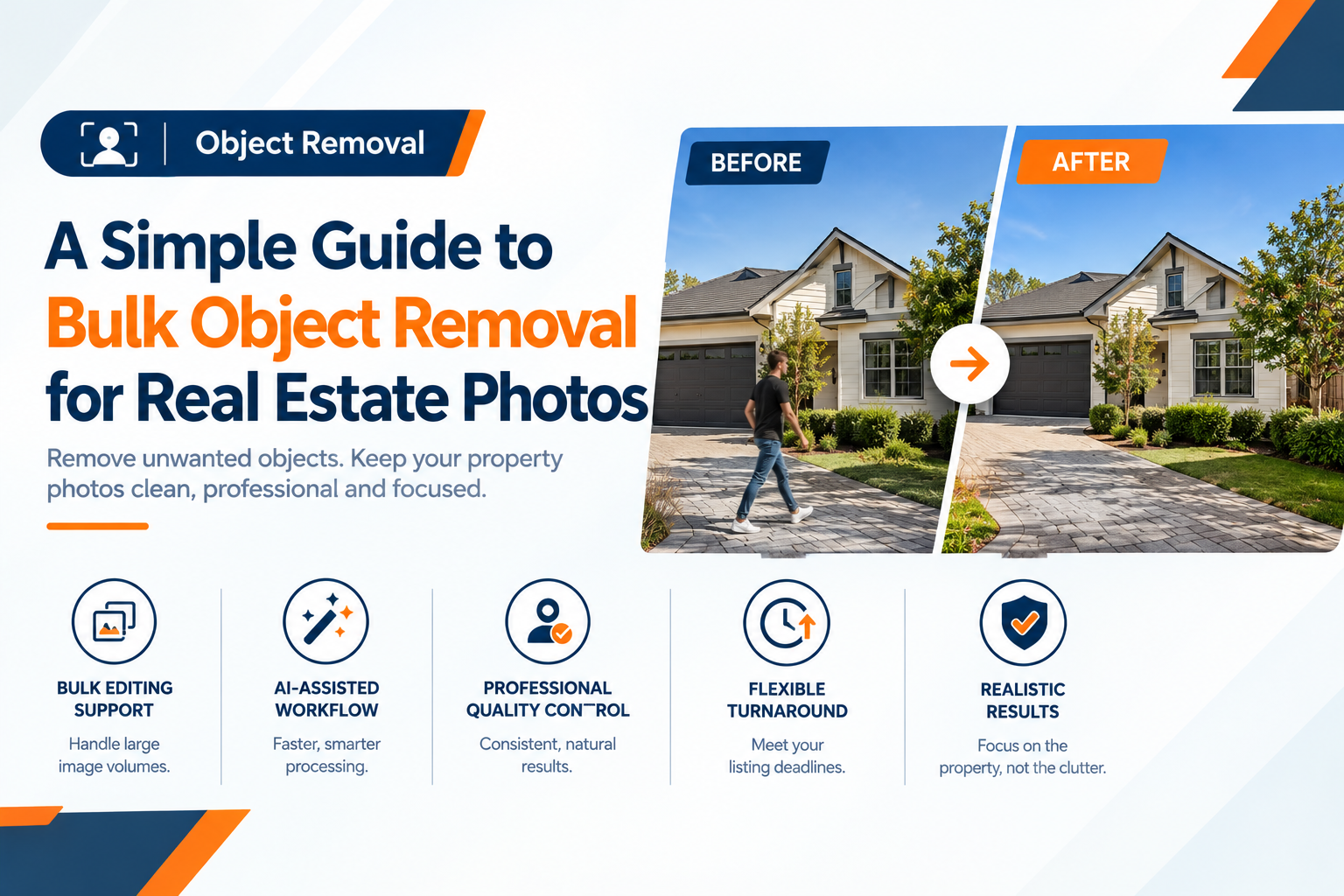
Introduction
For a real estate agency, photography company, property marketing team, or listing operation handling hundreds of property images, object removal is rarely just a one-image editing task.
A single property may contain unwanted furniture, rubbish bins, vehicles, people, signs, wires, clutter, construction materials, or other distractions. When the same requirement applies across dozens or hundreds of listings, the editing process becomes a production workflow.
This is where bulk object removal becomes important.
Instead of looking only at the cost of editing one photograph, agencies need to consider image volume, object complexity, editing quality, turnaround requirements, revisions, consistency, and quality control. A simple object may require only a straightforward removal, while a complex object overlapping architectural details may require detailed masking and background reconstruction.
1. What Does Bulk Object Removal Mean?
Bulk object removal refers to removing unwanted elements from a large number of property photographs as part of a structured editing workflow.
Instead of sending one or two images occasionally, an agency might submit:
- 50 property photographs
- 100 listing images
- 500 photographs across multiple properties
- 1,000+ images as part of a recurring workflow
The objects may include:
- Furniture
- Vehicles
- People
- Bins and rubbish
- Wires and cables
- Signs and banners
- Logos
- Construction materials
- Personal belongings
- Small clutter
- Unwanted background elements
The important difference is that bulk editing requires consistency and production management, not simply removing an object from an individual photograph.
2. Why High-Volume Agencies Need a Different Editing Workflow
A high-volume agency cannot always treat every image as a separate editing task.
When hundreds of images are involved, the team needs a workflow that can manage:
- File organization
- Batch processing
- Editing instructions
- Image priorities
- Quality standards
- Delivery schedules
- Revisions
- Final quality checks
For example, an agency managing multiple property listings may want the same types of unwanted elements removed from every listing.
Without a defined workflow, different editors may produce different results. One image may have natural-looking background reconstruction, while another may show visible cloning or inconsistent textures.
A professional property image cleanup service therefore needs to balance automation with quality control.
3. How Object Removal Pricing Is Commonly Calculated
Bulk object removal pricing can be structured in several ways.
Per-Image Pricing
The provider charges according to the number of images edited.
This can be straightforward for agencies because the approximate project cost can be estimated from the number of images.
However, per-image pricing does not necessarily mean every image requires the same amount of work.
Volume-Based Pricing
Larger image volumes may be handled through a different pricing structure based on the overall workload.
For example, a project containing 500 images may be assessed differently from a small order containing 20 images.
Package Pricing
Some agencies may prefer project or package-based arrangements for recurring workloads.
This can make sense when the agency has predictable monthly requirements.
Complexity-Based Pricing
The complexity of the object removal may also influence the quote.
A simple removal and a complex reconstruction are not necessarily equivalent editing tasks, even when both involve only one object.
The most useful approach is therefore to provide the editing company with representative sample images before requesting a final quote.
4. Main Factors Affecting Bulk Object Removal Cost
The number of images is important, but it is not the only factor.
Image Volume
A project involving 50 images has a different production requirement from one involving 500 or 1,000 images.
Larger projects require more structured processing, file management, quality control, and delivery planning.
Object Complexity
Removing a small isolated object from an uncomplicated background can be relatively straightforward.
Objects overlapping:
- Walls
- Windows
- Furniture
- Architectural features
- Textures
- Reflections
- Shadows
- Landscaping
may require considerably more editing.
Background Reconstruction
When an object is removed, the empty area has to be reconstructed.
This can involve recreating:
- Wall textures
- Flooring
- Grass
- Tiles
- Furniture surfaces
- Architectural details
- Patterns
The more information that needs to be reconstructed, the more complex the edit can become.
Image Quality
High-resolution photographs with clear details may provide more information for editing.
Low-resolution, compressed, blurry, or heavily processed images can make accurate reconstruction more difficult.
Turnaround Time
Standard turnaround and rush delivery can require different production planning.
If an agency needs hundreds of images completed within a very short deadline, additional resources may be necessary.
Quality Control
AI or automated processing may complete the initial edit, but agencies may still require human review before publishing.
Quality-control requirements can therefore influence the overall workflow and cost.
Revisions
A project with clearly defined requirements may require fewer revision cycles than a project where editing instructions change after delivery.
5. Simple vs Complex Object Removal Examples
Understanding complexity is one of the easiest ways for an agency to understand bulk editing costs.
Simple Examples
These may include:
- Small rubbish bins
- Minor clutter
- Small isolated objects
- Simple background distractions
- Small signs on uncomplicated surfaces
These edits may require relatively limited reconstruction.
Moderate Examples
Examples may include:
- Larger furniture
- Multiple objects
- People
- Vehicles
- Medium-sized signs
- Objects near architectural features
These can require more careful masking and reconstruction.
Complex Examples
Complex object removal may include:
- Large furniture covering detailed flooring
- Vehicles overlapping landscaping
- Objects crossing architectural structures
- Wires against detailed backgrounds
- Objects affecting reflections
- Objects casting significant shadows
- Large objects covering textured surfaces
These situations may require manual editing, detailed masking, texture reconstruction, and careful quality control.
6. AI-Powered Object Removal vs Manual Editing
AI has changed how property photo editing can be performed.
Tools using AI inpainting, Generative Fill, and similar technologies can identify an unwanted object and generate replacement content based on the surrounding image.
This can make certain repetitive edits faster.
However, AI and manual editing serve different purposes.
AI-Assisted Editing
AI can be useful for:
- Repetitive object removal
- Simple backgrounds
- High-volume initial processing
- Small isolated objects
- Rapid first-pass editing
Manual Editing
Professional manual editing can be useful when:
- Background reconstruction is complicated
- Architectural edges are involved
- Reflections need correction
- Shadows need rebuilding
- AI produces artifacts
- The object overlaps important property details
- The image requires precise retouching
A practical workflow can therefore combine both approaches:
AI-assisted processing → professional refinement → manual quality assurance
The objective is not to use AI simply because it is available. The appropriate workflow depends on the image, object complexity, quality expectations, and project volume.
7. When AI Works Well for Bulk Projects
AI-powered object removal can be particularly useful when an agency has a large number of relatively straightforward images.
For example, a batch may contain small objects that appear against simple backgrounds.
AI can help reduce repetitive manual work and support a scalable production process.
For agencies handling hundreds of images, this can be useful because automation can process repetitive tasks before human quality control is applied.
However, agencies should avoid assuming that every AI-generated result will be publication-ready.
A batch should still be reviewed according to the required quality standard.
8. When Manual Intervention Is Necessary
Manual intervention becomes more important when the removed object affects complex visual information.
Consider a photograph where a vehicle is covering part of a patterned driveway.
Simply removing the vehicle is not enough. The editor may need to reconstruct the driveway pattern and ensure that perspective remains consistent.
Similarly, removing a person from a photograph may require rebuilding:
- Flooring
- Walls
- Furniture
- Shadows
- Reflections
- Background details
Manual editing can also be necessary when AI generates unnatural textures, distorted lines, repeated patterns, or inconsistent architectural details.
For agencies, this is why the AI vs manual editing discussion should focus on workflow suitability rather than assuming one method is universally better.
9. How Image Volume Can Influence Pricing
Volume is a major consideration in bulk object removal.
Imagine an agency has:
- 50 images
- 100 images
- 500 images
- 1,000 images
The number of images directly affects the total production workload.
However, volume alone does not determine the final cost.
For example, 500 simple images may require a very different workflow from 500 complex images containing furniture, vehicles, reflections, and architectural obstructions.
Agencies should therefore provide:
Approximate monthly image volume
Typical image resolution
Examples of objects requiring removal
Expected turnaround
Required output format
Quality expectations
Revision requirements
This gives the provider enough information to evaluate the actual workload.
10. Turnaround Time and Rush-Order Considerations
Turnaround is especially important for real estate agencies because listing schedules can be time-sensitive.
An agency may need photographs edited before:
- A listing goes live
- A property campaign begins
- A brochure is published
- A new development launches
- A marketing campaign starts
A predictable production workflow is therefore important.
Standard projects can usually be planned according to normal production capacity, while urgent batches may require priority processing.
If rush editing is regularly required, agencies should discuss it before starting a long-term partnership rather than treating every project as an emergency.
11. Quality Control Requirements for Agencies
Quality control is one of the most important parts of high-volume editing.
An image can technically have an object removed while still looking unnatural.
Editors should check for:
- Visible cloning
- Repeated textures
- Distorted architecture
- Incorrect perspective
- Artificial shadows
- Broken reflections
- Unnatural edges
- Missing details
- AI-generated artifacts
- Colour inconsistencies
For large batches, quality control should ideally follow a defined standard.
The agency and editing provider can agree on what constitutes an acceptable final image before the main batch is processed.
This can reduce disagreements and unnecessary revisions.
12. Revision Policies and Consistency Across Large Batches
Revisions become more complicated as project size increases.
If an agency orders 10 images, a revision may be easy to manage.
If the project contains 500 images, unclear revision instructions can slow the entire workflow.
Before starting, agencies should clarify:
- How revisions are submitted
- Whether revisions are included
- How revision requests are tracked
- Whether revised images retain the same editing style
- How batch-wide corrections are handled
- How final approvals are communicated
Consistency also matters.
If five editors work on the same property campaign, the final images should follow the same visual standards.
13. How to Calculate an Estimated Project Budget
Agencies can create a simple workload estimate without assuming a universal industry price.
Start by separating the images into complexity groups.
For example:
Editing Level
Example
Estimated Workload
Simple
Small clutter, bins, isolated objects
Lower complexity
Moderate
Furniture, people, signs, vehicles
Medium complexity
Complex
Reflections, shadows, architecture, large objects
Higher complexity
Then calculate:
Total Estimated Workload = Image Volume × Editing Complexity
For example, an agency receiving 500 images should not automatically assume that all 500 require the same editing effort.
Instead, the team can identify:
- 250 simple images
- 175 moderate images
- 75 complex images
The provider can then assess the representative images and create a project-specific quotation.
This approach is more useful than applying one assumed price to every photograph.
14. What Agencies Should Ask an Editing Provider Before Starting
Before hiring a professional object removal service for agencies, ask the provider:
Pricing
- Is pricing per image, package, volume, or complexity?
- Is there a minimum order quantity?
- Are complex images priced differently?
- What information is required for a quotation?
Workflow
- Is AI used?
- Is manual editing available?
- Is every image reviewed?
- How are complex images handled?
Quality
- How is quality assurance performed?
- How are AI artifacts corrected?
- How is consistency maintained across batches?
Turnaround
- What is the standard turnaround?
- Is rush processing available?
- How are urgent projects scheduled?
Revisions
- How are revisions handled?
- How are batch-wide corrections managed?
- Is there a defined approval process?
Delivery
- What file formats are supported?
- How are completed images delivered?
- How are large batches organized?
These questions help agencies compare providers based on workflow compatibility rather than looking only at the headline price.
15. How to Reduce Unnecessary Bulk Editing Costs
Agencies can often reduce unnecessary workload by improving their submission process.
Provide Clear Instructions
Tell the editing provider exactly what should be removed.
For example:
Remove the red chair, garden bin, parked vehicle and visible cable.
Clear instructions reduce interpretation and revision time.
Group Similar Requirements
If the same type of object needs to be removed across a batch, communicate this as a consistent requirement.
Send Representative Samples
Before processing hundreds of images, send a small sample that represents the expected workload.
This allows the provider to understand the complexity before the full project begins.
Avoid Unnecessary Editing
Not every object needs to be removed.
If an element is natural to the property and does not distract from the listing, removing it may not provide meaningful value.
Establish a Quality Standard
Agree on what the final images should look like before production begins.
This can reduce unnecessary revisions.
16. Choosing a Reliable High-Volume Object Removal Partner
For high-volume agencies, choosing an editing provider is about more than finding a low per-image cost.
A suitable partner should be able to support the agency's actual production requirements.
Look for a workflow that can handle:
- Bulk object removal
- AI-assisted processing
- Professional manual editing
- Quality assurance
- Consistent output
- Defined turnaround times
- Revision management
- Recurring workloads
- Large image volumes
It is also useful to test the provider with representative images before committing to a large recurring workflow.
For example, an agency managing residential listings can submit several images containing different levels of complexity.
The test can reveal how the provider handles:
- Furniture
- Vehicles
- People
- Wires
- Signs
- Shadows
- Reflections
- Background reconstruction
This gives the agency a more realistic understanding of the editing workflow.
For businesses operating in markets such as South India, Chennai, Tamil Nadu, Dubai, or the wider UAE property sector, a provider's ability to support recurring workflows and communicate clearly can be just as important as the editing method itself.
17. FAQs
How much does bulk object removal cost?
There is no universal bulk object removal price. Cost can depend on image volume, object complexity, background reconstruction, turnaround, quality-control requirements, and revisions. Agencies should request a project-specific quotation using representative images.
Is AI object removal cheaper than manual editing?
AI can reduce repetitive editing work, but it should not automatically be assumed to be cheaper for every project. Complex images may still require professional manual intervention and quality control.
How much does object removal cost for 100 property photos?
The cost for 100 property photos depends on the type and complexity of the objects being removed. A batch of simple images may require a different workflow from 100 photographs involving vehicles, furniture, reflections, or architectural reconstruction.
How much does bulk object removal cost for 500 photos?
A 500-image project should be evaluated based on the actual editing workload. Agencies should provide sample images, object-removal requirements, quality expectations, and turnaround requirements before requesting a quotation.
What objects can be removed from real estate photos?
Common examples include furniture, vehicles, people, bins, wires, signs, banners, clutter, rubbish, personal belongings, and other unwanted distractions.
Can AI remove furniture from property photos?
AI-powered tools can assist with furniture removal, particularly where the surrounding background is relatively simple. Complex furniture removal may require manual reconstruction and quality control.
Why is background reconstruction important?
When an object is removed, the area behind it must be recreated. The editor may need to reconstruct textures, flooring, walls, landscaping, architectural details, shadows, or other visual elements.
Should every object be removed from a property photograph?
No. Object removal should support the property's presentation without unnecessarily changing the visual information. Agencies should remove genuine distractions while maintaining a realistic representation of the property.
How can an agency manage thousands of property images?
A structured workflow can combine batch processing, clear editing instructions, automated or AI-assisted processing, manual quality control, revision management, and organized delivery.
What should I send when requesting a bulk object removal quote?
Send the approximate image volume, sample images, object-removal requirements, expected turnaround, preferred output format, quality expectations, and any recurring workflow requirements.
18. Conclusion
Bulk object removal is fundamentally a workflow and scalability challenge.
For agencies handling large property image volumes, the cost of editing depends on more than simply counting photographs. Object complexity, image quality, background reconstruction, AI processing, manual intervention, turnaround requirements, quality assurance, and revisions can all influence the total workload.
AI-powered object removal can support high-volume production, particularly for repetitive and relatively straightforward edits. However, complex property photographs may still require professional manual editing and quality control.
The most practical approach is to evaluate the complete workflow rather than choosing a provider based only on a quoted per-image number.
By sharing representative images, defining editing requirements, establishing quality standards, and discussing turnaround and revision policies in advance, agencies can create a more predictable bulk photo editing process.
For businesses managing recurring property listings, the right real estate object removal service should be able to scale with the workload while maintaining consistent, realistic results.
19. Streamline High-Volume Property Editing with Professional Object Removal from Voxelhaus Consultancy
If your agency manages a large volume of property photographs, Voxelhaus Consultancy can support bulk object removal workflows for real estate listings and property marketing requirements.
Share your approximate image volume and the types of objects you need removed. The workflow can be assessed based on:
- Bulk object removal requirements
- AI-assisted editing
- Professional manual quality control
- Image complexity
- Consistency requirements
- Turnaround expectations
- Recurring agency workloads
- Individual or large property-image batches
Instead of relying on a generic per-image assumption, your project can be evaluated according to the actual editing requirements.
Send your property images and project details to Voxelhaus Consultancy to discuss a suitable bulk object removal workflow and project-specific quotation.