1. What Is Virtual Home Staging?
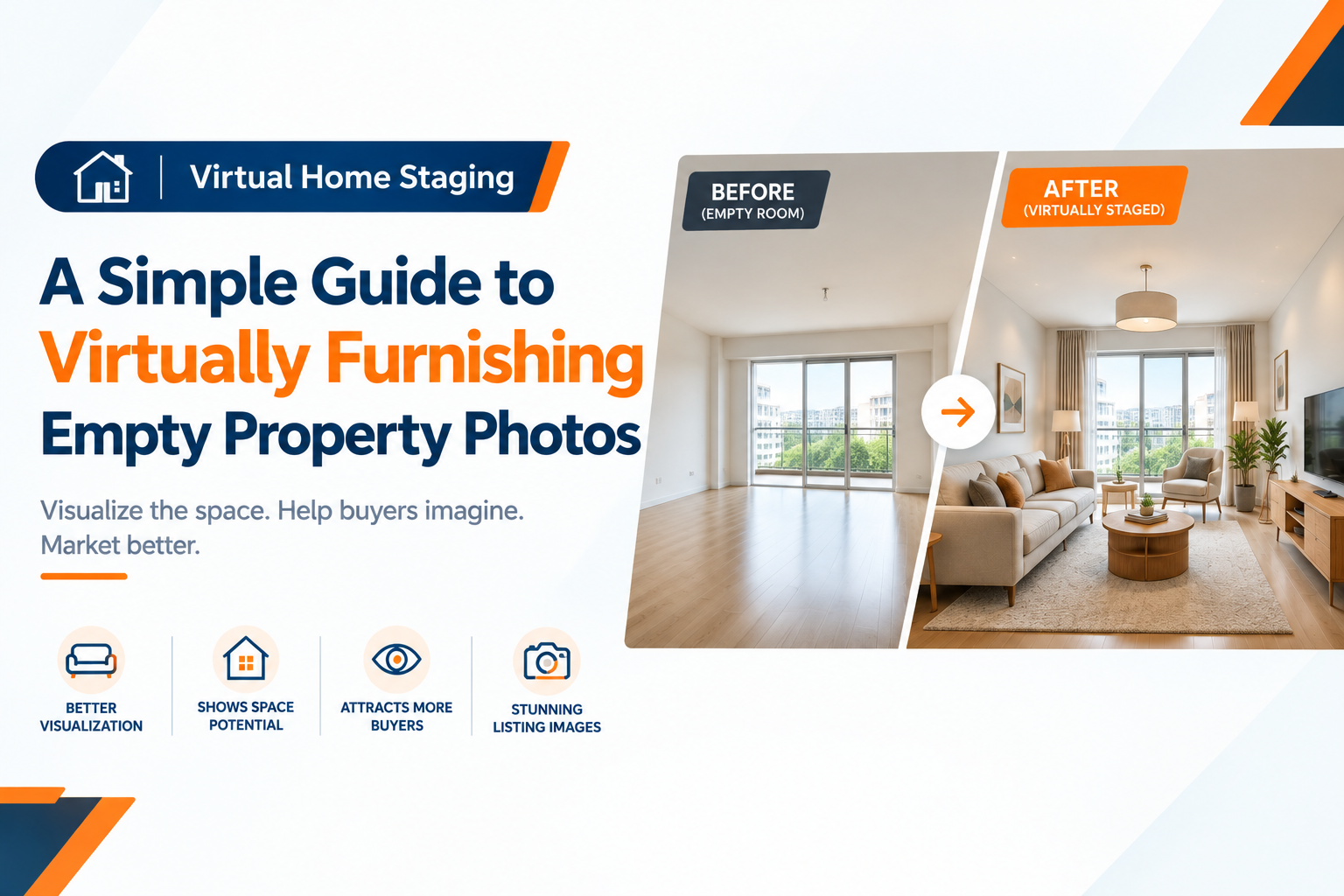
Virtual home staging means digitally furnishing an existing property photograph.
Instead of physically placing furniture inside a vacant room, digital furniture and décor are added during the image-editing process.
For example, an empty living room can be digitally transformed by adding:
- Sofa
- Coffee table
- Television unit
- Rug
- Curtains
- Artwork
- Lamps
- Decorative accessories
A bedroom could include:
- Bed
- Bedside tables
- Wardrobe
- Rug
- Lighting
- Artwork
- Decorative elements
The original room remains the foundation of the image. The furniture and décor are digitally incorporated into the photograph.
This makes virtually furnish and decorate empty property photos online a practical approach for property marketing when physical staging is not being used.
The purpose is not to change the property's architecture. Instead, it is to help viewers visualize how the existing space could potentially be furnished.
2. How Does Virtual Staging Work?
The process can vary depending on the provider and project, but a professional workflow generally involves several stages.
Step 1: Property Photograph Selection
The process begins with a suitable photograph of the empty room.
A good source image should clearly show the room, walls, floor, windows and architectural features.
Step 2: Image Review
The editor reviews:
- Room dimensions
- Camera angle
- Perspective
- Existing lighting
- Windows and doors
- Architectural details
- Available floor space
Step 3: Furniture and Style Selection
Furniture is selected according to the property's intended audience and requested interior style.
Step 4: Digital Furniture Placement
Furniture and décor are positioned digitally within the photograph.
Step 5: Perspective Matching
The furniture needs to follow the room's existing perspective.
Step 6: Lighting and Shadow Matching
Digital furniture should appear to belong naturally in the photographed environment.
Step 7: Refinement
The image is reviewed for:
- Incorrect proportions
- Floating furniture
- Artificial shadows
- Perspective errors
- Visual inconsistencies
- Unnatural textures
Step 8: Quality Control and Delivery
The completed image is checked before being delivered in the required format and resolution.
The overall workflow can therefore be summarized as:
Property photograph → Review → Style selection → Digital furniture placement → Perspective matching → Lighting and shadows → Refinement → Quality control → Listing-ready image
3. Why Do Empty Property Photos Benefit From Virtual Staging?
An empty property is not necessarily difficult to market, but vacant rooms can sometimes be harder for viewers to visualize.
Furniture provides visual references for scale and function.
For example, an empty room may leave a buyer wondering:
- Where would a sofa fit?
- Is there enough space for a dining table?
- Could this room work as a home office?
- How large could a bed be in this bedroom?
- How could the available floor area be arranged?
A staged image can provide a visual example.
This does not mean that virtual staging guarantees a sale or higher property value. Instead, it gives potential buyers another way to interpret the space while browsing a listing.
For online property marketing, this can be particularly useful because buyers often review multiple properties before deciding which ones they want to visit.
4. Which Rooms Can Be Virtually Staged?
Almost any suitable interior photograph can potentially be virtually staged.
Living Rooms
Living rooms are among the most common spaces for staging.
Furniture may include:
- Sofa
- Coffee table
- Television unit
- Armchairs
- Rug
- Side tables
- Decorative accessories
Bedrooms
Bedrooms can be furnished with:
- Bed
- Bedside tables
- Lamps
- Wardrobe
- Rug
- Artwork
Dining Rooms
Dining areas may include:
- Dining table
- Dining chairs
- Pendant lighting
- Sideboard
- Decorative elements
Home Offices
A vacant room can be presented as a potential home office with:
- Desk
- Office chair
- Shelving
- Lighting
- Minimal décor
Premium Interiors
Luxury or high-end properties may require more carefully selected furniture, materials and décor to suit the architectural character of the property.
The key is to stage each room according to its purpose rather than using the same furniture style everywhere.
5. What Furniture and Décor Can Be Added?
Virtual staging can include many different types of digital furniture and decorative elements.
Examples include:
- Sofas
- Beds
- Dining tables
- Chairs
- Desks
- Coffee tables
- Rugs
- Curtains
- Lamps
- Artwork
- Plants
- Shelving
- Sideboards
- Decorative accessories
The selection should match the room.
For example, placing oversized furniture inside a small bedroom may make the room appear smaller than it actually is.
Similarly, using highly luxurious furniture in a modest property may create a visual mismatch.
Good virtual staging considers the property itself rather than treating every room as a generic interior.
6. Popular Virtual Staging Styles
Different properties can benefit from different interior styles.
Modern
Modern staging may use:
- Clean furniture shapes
- Simple décor
- Neutral colours
- Minimal decorative elements
Contemporary
Contemporary interiors can combine modern furniture with warmer textures and more decorative details.
Scandinavian
Scandinavian styling often emphasizes:
- Light colours
- Simple furniture
- Natural-looking materials
- Clean layouts
- Minimal décor
This style can work well when a bright, uncluttered presentation is desired.
Luxury
Luxury virtual staging may use:
- Premium-looking furniture
- Elegant lighting
- Refined décor
- Higher-end visual finishes
The style should still be appropriate to the actual property.
Neutral
Neutral staging uses restrained furniture and décor to keep attention on the property rather than a highly specific design personality.
There is no universally best staging style. The appropriate choice depends on the property, target audience, location and marketing strategy.
7. How Do You Choose the Right Interior Style?
Before ordering virtual staging, consider the property's:
- Architecture
- Size
- Location
- Target buyer
- Price segment
- Existing finishes
- Natural lighting
- Intended marketing position
For example, a compact city apartment may work well with a modern or Scandinavian interior.
A large premium villa may call for a more sophisticated contemporary or luxury presentation.
The objective should be to make the room visually understandable without creating an interior that feels disconnected from the actual property.
If you are unsure, you can provide the staging provider with a reference image or describe the preferred style.
8. Virtual Staging vs Traditional Home Staging
Virtual staging and traditional home staging have the same broad purpose—helping people visualize a property as a furnished space—but the process is different.
Virtual Home Staging
Traditional Home Staging
Furniture is digitally added to photographs
Physical furniture is placed inside the property
No physical furniture delivery is required
Furniture must be transported and arranged
Works directly with property photographs
Takes place inside the actual property
Multiple styles can be explored digitally
Physical setup must be changed for different styles
Useful for online listing images
Useful for physical property viewings
Based on image editing and visualization
Based on physical interior arrangement
Virtual staging is therefore particularly relevant when the main objective is improving the visual presentation of online listing photographs.
It does not replace the physical experience of walking through a furnished property.
9. AI-Assisted vs Professional Virtual Staging
AI-assisted tools can now help create digitally furnished property images.
They may automate tasks such as:
- Furniture generation
- Object placement
- Room styling
- Image enhancement
However, automation does not automatically guarantee a professional result.
AI-generated furniture may sometimes have:
- Incorrect proportions
- Unusual shapes
- Perspective problems
- Inconsistent shadows
- Strange textures
- Architectural interference
Professional virtual staging can combine digital tools with human review and refinement.
A useful workflow can be:
AI-assisted processing → professional refinement → quality control
This approach can provide the efficiency of digital automation while allowing an editor to check the final result.
10. What Makes a Virtually Staged Image Look Realistic?
Realism is one of the most important considerations in virtual staging.
A staged image should look like furniture has been naturally placed inside the photographed room.
Important factors include:
Correct Perspective
Furniture should follow the camera's perspective.
Appropriate Scale
A sofa, bed or table should have proportions that make sense for the room.
Natural Shadows
Furniture should interact visually with the room's lighting.
Consistent Lighting
The brightness and direction of digital furniture should be compatible with the original photograph.
Realistic Textures
Materials such as wood, fabric, glass and metal should look natural.
Architectural Accuracy
Furniture should not incorrectly cover or distort doors, windows, walls or other permanent property features.
Consistent Colour
The furniture should fit naturally into the photograph rather than appearing pasted into it.
These details can make the difference between a convincing staged image and an obviously edited photograph.
11. Why Perspective and Furniture Scale Matter
Imagine a small apartment with a compact living room.
If a virtual staging editor places an oversized sofa into the room, the furniture may technically fit the photograph but still look unrealistic.
Similarly, if a dining table is too small relative to the room, the space may appear unusually large.
Perspective and scale therefore need to work together.
The editor should consider:
- Camera height
- Camera angle
- Floor perspective
- Wall lines
- Furniture dimensions
- Distance from the camera
- Relationship between furniture and architectural features
This is particularly important when creating digitally furnished property photos for listing purposes.
12. How Lighting, Shadows and Reflections Are Matched
Lighting is another important part of realistic virtual staging.
Suppose sunlight enters a room from the right side of the photograph.
The digitally added furniture should not appear to be illuminated from the opposite direction without a visual reason.
Similarly, shadows should relate to the existing light.
Depending on the image, editors may need to consider:
- Light direction
- Brightness
- Shadow softness
- Window light
- Floor reflections
- Glass surfaces
- Material response
If these elements are ignored, the furniture may appear visually disconnected from the room.
Professional virtual staging therefore involves more than choosing furniture. It also involves integrating that furniture into the existing photograph.
13. What Should You Send to a Virtual Staging Provider?
Before ordering a virtual staging service, provide as much useful information as possible.
You may need to send:
Property Photographs
High-quality photographs provide the foundation for the staging process.
Preferred Interior Style
Tell the provider whether you prefer:
- Modern
- Contemporary
- Scandinavian
- Luxury
- Neutral
- Another specific style
Room Purpose
Identify whether each photograph shows:
- Living room
- Bedroom
- Dining area
- Home office
- Other space
Furniture Preferences
If you have specific furniture requirements, communicate them before editing begins.
Reference Images
Reference images can help communicate the desired visual direction.
Marketing Requirements
Tell the provider where the images will be used, such as:
- Property listing
- Real estate website
- Brochure
- Social media
- Advertising
Clear requirements can reduce unnecessary revisions.
14. How Much Does Virtual Staging Cost?
There is no single universal price for virtual staging.
The cost can depend on several factors, including:
- Number of images
- Number of rooms
- Image complexity
- Furniture requirements
- Level of realism
- Interior style
- CGI or image-compositing requirements
- Resolution
- Turnaround time
- Number of revisions
- Bulk volume
For example, a simple empty living room may require a different level of work from a complex premium interior with multiple architectural details.
When comparing an affordable virtual staging service for empty apartments online, avoid comparing providers based only on the lowest price.
Instead, consider:
- Final image quality
- Realism
- Furniture selection
- Perspective matching
- Revision policy
- Turnaround
- Quality control
- File delivery
A lower price is not necessarily better if the final image requires extensive corrections.
15. How Long Does Virtual Staging Take?
Turnaround time depends on the project.
Factors that can affect delivery include:
- Number of images
- Number of rooms
- Complexity
- Staging style
- Revision requirements
- Image quality
- Required output format
- Whether multiple images need to maintain the same visual style
If you have a listing deadline, communicate it before the project begins.
For agencies or photographers handling recurring properties, discussing a consistent workflow and expected turnaround can make future projects easier to manage.
16. Common Virtual Staging Mistakes Beginners Should Avoid
1. Choosing Furniture That Is Too Large
Oversized furniture can make a room appear smaller than it really is.
2. Using the Wrong Style
A staging style that does not suit the property can create a visual mismatch.
3. Ignoring Perspective
Furniture that does not follow the room's perspective can immediately look artificial.
4. Creating Unrealistic Shadows
Incorrect shadows can make furniture appear to float.
5. Overloading the Room
Too much furniture or décor can make the property look cluttered.
6. Changing the Property's Actual Architecture
Virtual staging should not incorrectly alter permanent features such as walls, windows or doors.
7. Using Highly Stylized Furniture Without a Reason
Extremely unusual furniture can distract viewers from the actual property.
8. Failing to Disclose Digital Staging
If an image has digitally added furniture, the property marketing should represent that clearly and responsibly.
9. Staging Every Room Identically
Different rooms have different purposes. A bedroom should not look like a living room with different furniture.
10. Focusing Only on Price
Quality, realism, consistency and communication are important when selecting a provider.
17. How to Choose a Reliable Virtual Staging Company
When looking for a virtual staging company for real estate listings, review several factors.
Portfolio Quality
Look at previous examples and examine whether the furniture appears naturally integrated.
Realism
Check:
- Perspective
- Scale
- Shadows
- Lighting
- Textures
- Reflections
Style Options
A good provider should be able to work with different property styles rather than forcing every listing into one visual template.
Communication
Requirements should be clearly understood before editing starts.
Revisions
Ask how corrections are handled if furniture selection or styling needs adjustment.
Turnaround
Confirm whether the expected delivery fits your listing schedule.
Consistency
If you are submitting multiple photographs from the same property, the staging style should remain visually consistent.
Quality Control
Human review can help identify AI or compositing artifacts before delivery.
File Quality
Confirm that the final images meet the resolution and format requirements of the intended platform.
18. When Is Virtual Staging Appropriate?
Virtual staging can be particularly useful when:
- A property is completely vacant.
- Empty rooms are difficult to visualize.
- The listing relies heavily on online photography.
- Physical staging is not being used.
- Multiple furniture styles need to be explored.
- A property needs a visually complete online presentation.
- A developer is marketing unfurnished spaces.
- A photographer or agency wants listing-ready images.
However, virtual staging is not necessary for every photograph.
If a room is already furnished and photographed well, additional digital furniture may not provide meaningful value.
The goal should be to improve understanding and presentation—not to edit an image simply because editing is available.
19. How Virtual Staging Supports Property Marketing
A property listing typically contains several types of information:
- Photographs
- Property description
- Location information
- Specifications
- Floor plans
- Contact information
Virtually staged images can become another visual component within this presentation.
For an empty property, they can show possible furniture arrangements and help viewers imagine how the available space might function.
For example:
Empty photograph → Virtually furnished photograph → Buyer visualizes possible use of the room
The staged image should still be treated as a visualization rather than evidence that the furniture physically exists inside the property.
Clear and responsible presentation helps maintain buyer expectations.
20. FAQs
What is virtual home staging?
Virtual home staging is the process of digitally adding furniture, décor and interior styling to photographs of an empty or vacant property.
How does virtual staging work?
A property photograph is reviewed, furniture and décor are selected, digital elements are placed into the room, and perspective, scale, lighting and shadows are adjusted before quality control and delivery.
Can I virtually furnish and decorate empty property photos online?
Yes. Empty property photographs can be digitally furnished using professional virtual staging workflows.
Which rooms can be virtually staged?
Living rooms, bedrooms, dining areas, home offices and many other suitable interior spaces can be virtually staged.
Is virtual staging the same as traditional home staging?
No. Traditional staging uses physical furniture inside the property, while virtual staging digitally adds furniture to property photographs.
Is AI virtual staging reliable?
AI can assist with furniture generation and image editing, but results can vary. Professional review can help identify perspective, scale, lighting, texture and architectural issues.
Can virtual staging make a property look larger?
Virtual staging can help viewers understand how furniture may fit into a room, but it should not be used to misleadingly alter the actual dimensions or proportions of the property.
What interior styles are available?
Depending on the provider, options can include modern, contemporary, Scandinavian, luxury, neutral and other styles.
How much does virtual staging cost?
Pricing varies based on image count, complexity, furniture requirements, style, realism, turnaround, revisions and other project requirements.
How long does virtual staging take?
Turnaround depends on the number and complexity of images, requested style, revisions and delivery requirements.
Should every room be virtually staged?
Not necessarily. Staging should be used where it genuinely helps viewers understand or visualize the space.
Can virtual staging be used for luxury properties?
Yes. Premium properties can be staged using carefully selected furniture, décor and interior styles that complement the property's architecture and marketing position.
Should digitally staged images be identified as staged?
Property marketing should make it clear when furniture or décor has been digitally added so viewers understand that the image is a visualization rather than a photograph of the physically furnished room.
Conclusion
An empty property does not have to look unfinished in its online presentation.
With virtual home staging, furniture, décor and interior styling can be digitally added to existing property photographs to help potential buyers visualize how the available space could be used.
The process involves much more than placing attractive furniture into an image. Realistic staging requires appropriate furniture selection, correct proportions, perspective matching, lighting consistency, natural shadows, realistic textures and careful quality control.
For first-time sellers, the most important point is to choose staging that supports the property's actual characteristics rather than creating an unrealistic version of the home.
For agents, photographers, developers and property marketing teams, professionally managed virtual staging can also provide a consistent approach across multiple listing photographs.
Whether you need an affordable digital staging approach for an apartment or a more refined presentation for a premium property, the right workflow should focus on realism, clarity and accurate property representation.
Virtual staging cannot guarantee that a property will sell or that its value will increase. Its role is simpler: help people visualize the possibilities of an empty space while browsing the property online.
Transform Empty Property Photos into Buyer-Ready Spaces with Professional Virtual Staging from Voxelhaus Consultancy
If you have empty property photographs that need a more complete visual presentation, Voxelhaus Consultancy can help transform those images with professional virtual staging.
The process can include digitally adding suitable:
- Furniture
- Décor
- Interior styling
- Living room arrangements
- Bedroom furniture
- Dining setups
- Home office concepts
- Contemporary interiors
- Modern interiors
- Scandinavian-inspired interiors
- Luxury interiors
The focus is on maintaining realistic perspective, proportions, lighting, shadows and overall presentation while digitally furnishing the original property photograph.
Voxelhaus Consultancy can also support consistent staging across multiple listing images, helping property owners, agents, photographers, developers and marketing teams create a unified visual presentation.
Whether you are preparing a single vacant property or handling multiple listing images, you can provide the property photographs, preferred style and requirements and use the resulting staged images as part of your broader property marketing workflow.
Send your empty property photos to Voxelhaus Consultancy and create professionally staged, listing-ready property images that help potential buyers visualize the space.